
The digital landscape is undergoing its most significant transformation since the birth of search engines. In 2026, we're witnessing a fundamental shift in how people discover information, how AI systems interpret content, and how businesses must adapt their visibility strategies. This isn't just an evolution—it's a paradigm shift from Search Engine Optimization (SEO) to Answer Engine Optimization (AEO), and it's reshaping the entire AI tools ecosystem.
This comprehensive report examines the forces driving this transformation, the new optimization frameworks emerging in 2026, and what it means for businesses, marketers, and the future of digital discovery. Based on the latest industry data, expert insights, and real-world case studies, we'll explore why traditional SEO is no longer sufficient and how AEO is becoming the new standard for online visibility.
Executive Summary: The State of Search in 2026
The numbers tell a stark story. In 2026, 58.5% of Google searches now end without a click—up from 25% just three years ago. When users interact with AI-powered answer engines like ChatGPT, Perplexity, or Google's AI Overviews, that number jumps to 83%. This means the majority of information discovery now happens without users ever visiting a website. citation
The implications are profound. Gartner projects that traditional search volume will drop by 25% by the end of 2026, with that traffic shifting to AI-powered answer engines and conversational interfaces. For businesses, this shift puts an estimated $750 billion in e-commerce revenue at stake as discovery patterns fundamentally change. citation citation
Yet despite this seismic shift, only 14% of marketers actively track their brand's visibility in AI-generated answers. The gap between the pace of change and organizational readiness has never been wider. Companies that built their entire digital strategy around ranking #1 on Google are discovering that position means far less when AI systems synthesize answers from multiple sources without sending traffic to any of them.
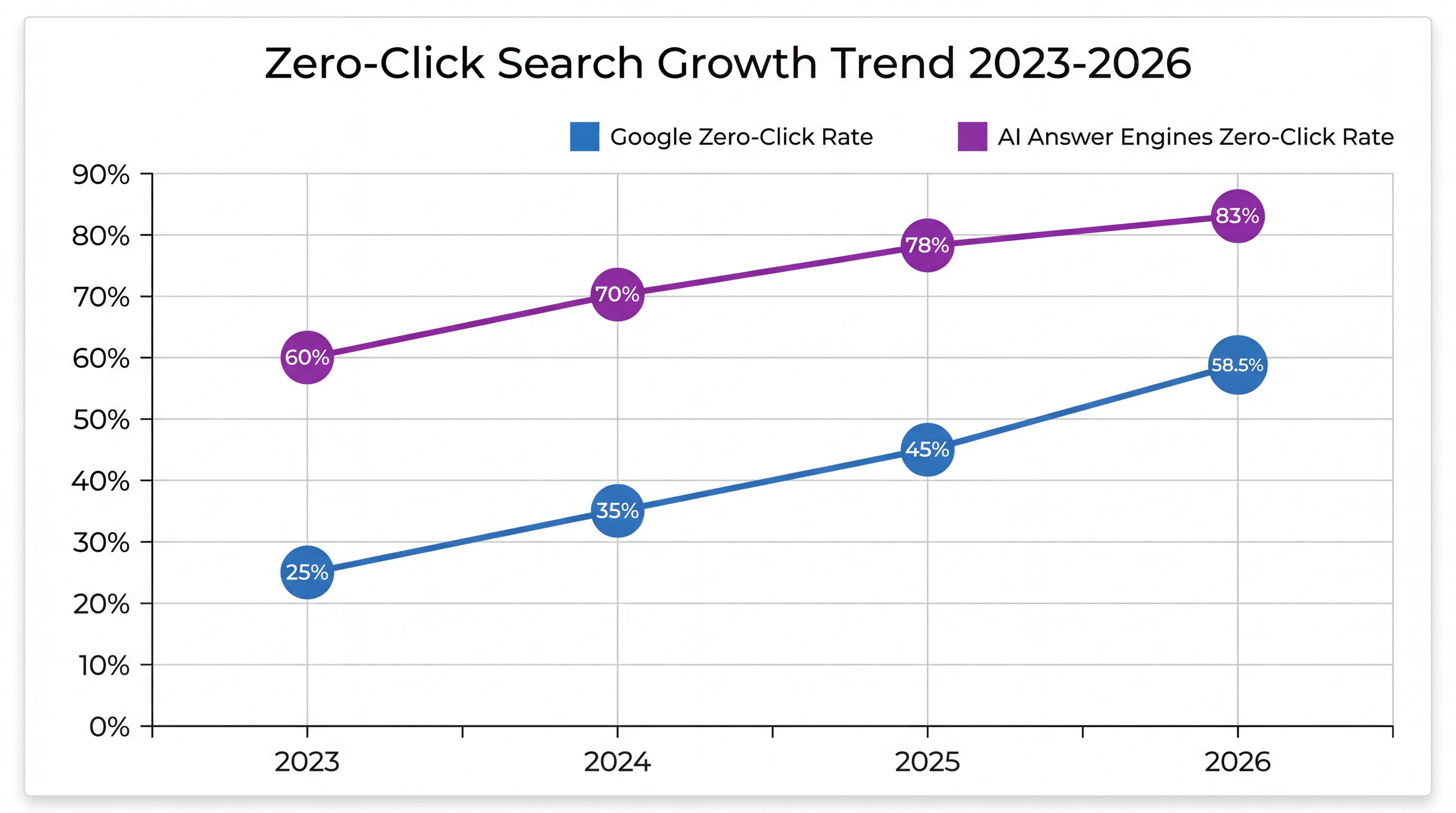
The dramatic rise of zero-click searches from 2023 to 2026, showing both Google and AI answer engines
This report breaks down what's happening, why it matters, and most importantly—what you need to do about it.
Understanding the New Landscape: SEO, AEO, GEO, and LLMO
The proliferation of acronyms in 2026—SEO, AEO, GEO, LLMO, SXO, AISEO—reflects a fundamental fragmentation in how optimization now works. Each term describes a slightly different angle on the same core problem: people are asking questions in conversational interfaces, getting answers without clicking, and the brands cited inside those answers are capturing visibility the rest of the web used to share. citation
Let's clarify what each term actually means and how they relate to each other:
SEO (Search Engine Optimization) - The Foundation Layer
Traditional SEO remains the infrastructure layer that everything else builds upon. It ensures your website is technically crawlable, fast, secure, and structured so search engines can index your content. SEO optimizes for ranking positions in a list of results—the classic "ten blue links" model.
Core Focus: Page rankings, organic traffic, keyword targeting, backlinks, technical performance
Primary Metric: Position in search results (e.g., ranking #3 for "AI presentation tools")
User Journey: User searches → sees your link in results → clicks → visits your site
Without strong SEO fundamentals, nothing else works. AI systems can't cite content they can't find or understand. But in 2026, SEO alone is no longer sufficient because the end goal has changed. citation
AEO (Answer Engine Optimization) - The Citation Layer
Answer Engine Optimization is the practice of structuring content so AI-powered answer engines like ChatGPT, Google's Gemini, Perplexity AI, and Claude can extract it, cite it, and deliver it as a direct answer to user queries. AEO optimizes for being selected as part of an answer rather than ranking in a list.
Core Focus: Citation-ready content, direct answers, structured data, entity clarity, extractable facts
Primary Metric: Citation rate (how often your brand appears in AI-generated answers)
User Journey: User asks AI → AI synthesizes answer → your brand is cited → user may or may not visit
The fundamental difference: SEO targets ranked positions in a list; AEO targets a binary citation outcome—your brand is either in the AI answer or it isn't. There's no position 2 or 3 in an AI-generated response. You're either cited or invisible. citation
GEO (Generative Engine Optimization) - The Ecosystem Layer
Generative Engine Optimization is the broader strategy of creating content that performs well across all generative AI systems—not just answer engines, but any AI that summarizes, synthesizes, and cites web content. GEO encompasses how AI models understand your brand at a conceptual level.
Core Focus: Brand authority signals, training data influence, multi-surface visibility, parametric memory
Primary Metric: Brand association strength across AI systems
Relationship to AEO: AEO and GEO overlap by approximately 80%. The practical difference is that GEO addresses the broader ecosystem (any generative engine), while AEO specifically focuses on being the answer to direct queries. citation
LLMO (Large Language Model Optimization) - The Training Layer
Large Language Model Optimization targets how LLMs themselves understand and reference your brand—whether your content appears in their training data, how the model describes your brand when generating responses, and ensuring accurate representation in the model's "parametric memory."
Core Focus: Training data presence, entity disambiguation, brand accuracy in model knowledge
Primary Limitation: Most businesses have limited leverage over what appears in OpenAI's or Anthropic's training datasets
Practical Reality: LLMO is a real concern for major brands but a poor focus for most SMBs. The actionable work happens at the AEO and GEO layers. citation
The Integrated Reality
In practice, these aren't separate strategies—they're layers of the same integrated approach. The most successful content in 2026 does all of them simultaneously:
-
SEO ensures discoverability and technical foundation
-
AEO optimizes for direct citation in AI answers
-
GEO builds brand authority across the AI ecosystem
-
LLMO influences long-term model understanding
The key insight: You can't do AEO without SEO, but SEO without AEO leaves you invisible in the fastest-growing discovery channel. citation
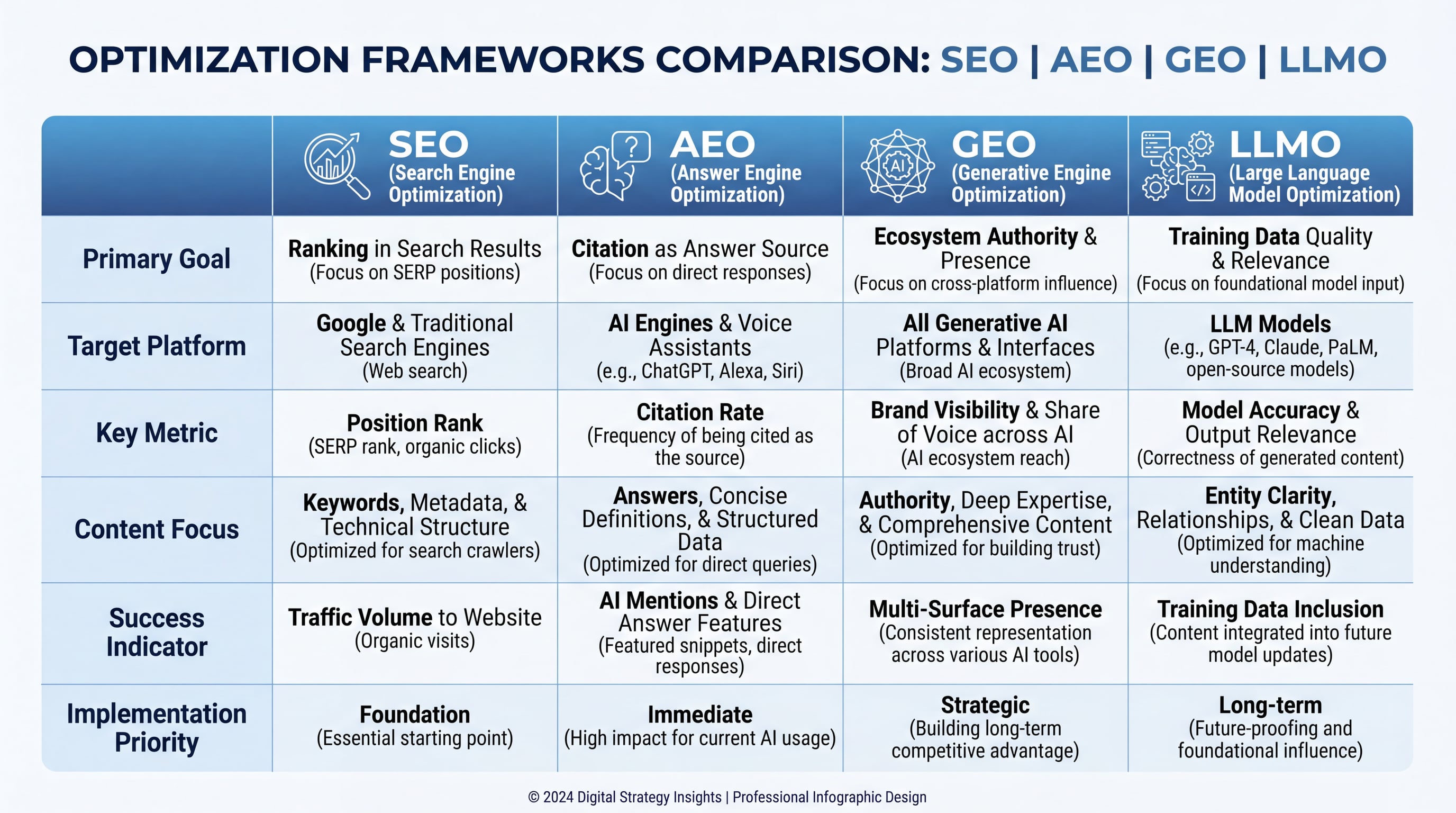
Comprehensive comparison of the four optimization frameworks and their key characteristics
Why the Shift is Happening: The Three Forces Driving Change
The move from SEO to AEO isn't a trend—it's the inevitable result of three converging forces that have fundamentally altered how information discovery works.
Force 1: The Rise of Zero-Click Search
The "zero-click search" phenomenon has been building for years, but 2026 marks its inflection point. When Google introduced featured snippets, knowledge panels, and People Also Ask boxes, it began answering questions directly on the search results page. Users got their answers without clicking through to websites.
AI Overviews have accelerated this dramatically. In 2026, 89% of brand-related searches now trigger an AI Overview—a synthesized answer generated by AI that appears above all traditional results. For informational queries, that number approaches 95%. citation
The user behavior shift is clear: when an AI provides a satisfactory answer, users don't click. They got what they needed. The website that would have received that click in 2023 now receives nothing—no traffic, no engagement, no conversion opportunity.
But here's the critical nuance: zero-click doesn't mean zero-value. Brands cited in AI answers see a 38% boost in organic clicks from other sources. AI visibility amplifies traditional SEO returns because citation builds awareness, credibility, and trust—even when users don't immediately click. citation
Force 2: The Fragmentation of Search Surfaces
Search is no longer synonymous with Google. In 2026, users ask questions across a fragmented landscape of surfaces:
-
ChatGPT (200M+ weekly active users) for research and problem-solving
-
Perplexity AI (15M+ monthly users) for source-backed answers
-
Google AI Overviews for quick facts and comparisons
-
Claude for professional and technical queries
-
Gemini integrated across Google's ecosystem
-
Voice assistants (Alexa, Siri, Google Assistant) for hands-free queries
-
Social search (TikTok, Instagram, Reddit) for recommendations
Each surface has its own optimization requirements. Content that performs well in ChatGPT may not surface in Perplexity. A brand visible in Google AI Overviews might be invisible to Claude. The days of optimizing for a single search engine are over. citation
Force 3: The Shift from Retrieval to Reasoning
Traditional search engines retrieve documents. They match keywords, analyze links, and return a ranked list of pages that might contain the answer. The user does the work of finding the actual answer within those pages.
AI answer engines reason. They understand the question, synthesize information from multiple sources, evaluate credibility, and generate a direct answer. The AI does the work of finding and presenting the answer. The user gets an immediate response.
This shift from retrieval to reasoning changes everything about optimization. It's no longer enough to have the right keywords or the most backlinks. Your content must be extractable (AI can pull out the key facts), quotable (statements are clear and attribution-ready), trustworthy (signals indicate reliability), and contextually relevant (fits the specific query intent). citation
The New Rules: How AEO Differs from Traditional SEO
Understanding the tactical differences between SEO and AEO is critical for adapting your strategy. Here's a comprehensive comparison:
Content Structure and Format
Traditional SEO Approach:
-
Long-form content (2,000+ words) to demonstrate depth
-
Keyword density and placement optimization
-
Content organized for human readers browsing a page
-
Internal linking to distribute page authority
AEO Approach:
-
Answer-first structure with direct responses in the first 2-3 sentences
-
Question-shaped content that mirrors how users ask queries
-
Extractable facts presented in clear, quotable statements
-
Structured data markup (FAQ schema, HowTo schema, Article schema) to help AI parse content
Example: An SEO-optimized article about "best AI presentation tools" might start with 200 words of introduction about the history of presentations. An AEO-optimized version starts with: "The best AI presentation tools in 2026 are Gamma (best for beginners), Beautiful.ai (best for visual quality), and Microsoft Copilot (best for Office users)." The AI can extract and cite this immediately.
Authority and Trust Signals
Traditional SEO Approach:
-
Backlinks from authoritative domains
-
Domain authority metrics
-
Content freshness and update frequency
AEO Approach:
-
E-E-A-T signals (Experience, Expertise, Authoritativeness, Trustworthiness)
-
Named authors with credentials and entity profiles
-
Citations to primary sources and authoritative references
-
Consistent entity information across the web (Wikidata, Knowledge Graph)
AI systems don't just count backlinks—they evaluate whether a source is trustworthy enough to cite. A page with perfect SEO but weak trust signals won't be cited by AI, even if it ranks #1. citation
Measurement and Success Metrics
Traditional SEO Metrics:
-
Keyword rankings (position 1-100)
-
Organic traffic volume
-
Click-through rate (CTR)
-
Bounce rate and time on page
AEO Metrics:
-
Citation rate (how often your brand appears in AI answers)
-
AI visibility score (presence across multiple AI platforms)
-
Mention quality (accuracy and context of citations)
-
Downstream traffic from AI citations
The shift is profound: SEO measures position in a list; AEO measures presence in answers. A brand can rank #1 in traditional search but have zero AI visibility—and increasingly, that #1 ranking delivers less value as users get their answers from AI instead. citation
Content Goals and User Intent
Traditional SEO Goal: Get users to click through to your website, then convert them once they arrive
AEO Goal: Be cited in the AI answer, build brand awareness and trust, then capture users who want deeper engagement
This represents a fundamental shift in the conversion funnel. In the SEO model, the click is the first step. In the AEO model, the citation is the first step—and many users will never click. Your content must deliver value even when users don't visit your site, because that citation builds the brand equity that drives conversions later. citation
The AEO Playbook: Practical Strategies for 2026
Based on analysis of thousands of AI citations and interviews with leading practitioners, here are the proven strategies for optimizing content for answer engines in 2026:
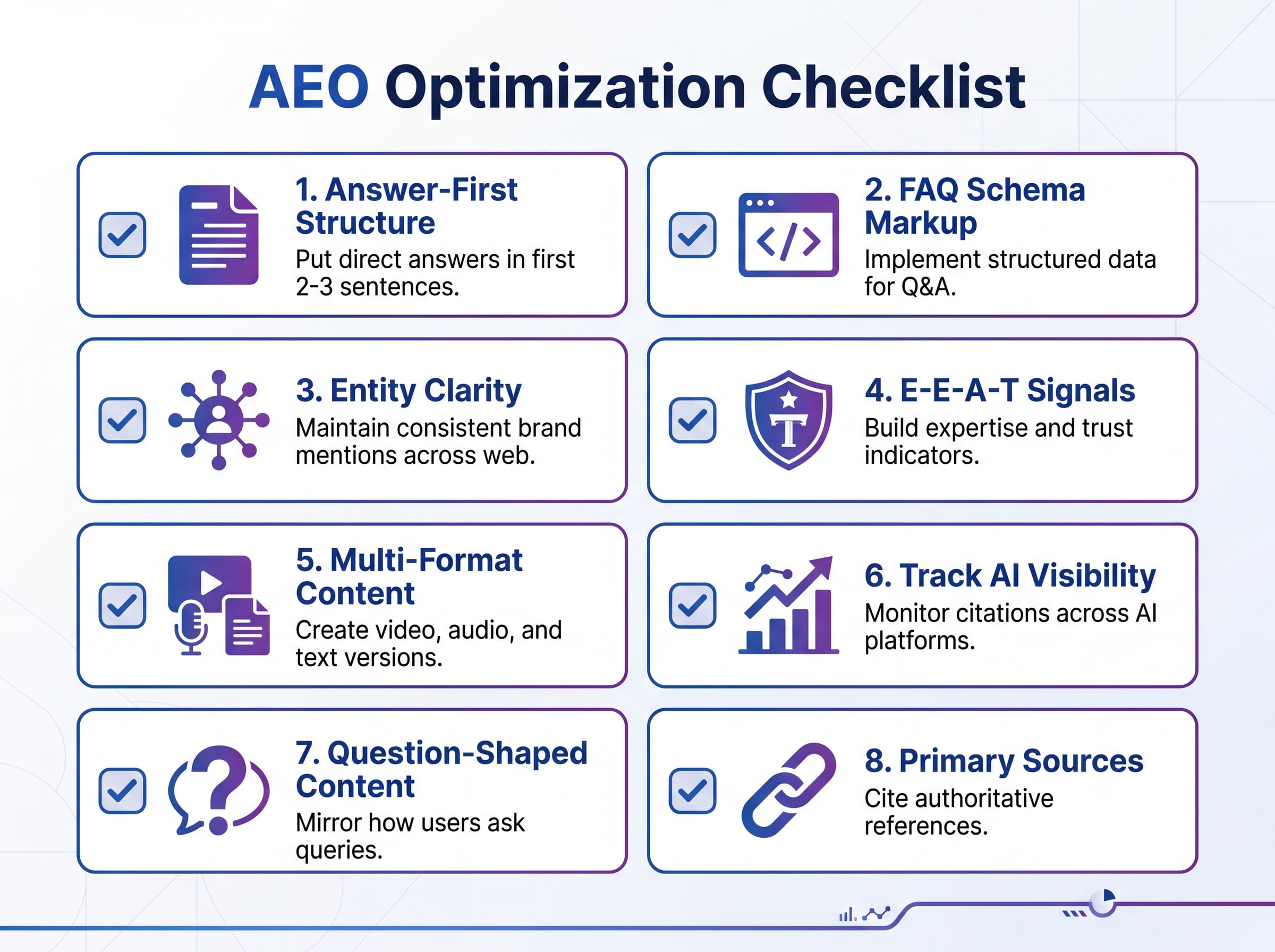
Essential checklist for implementing Answer Engine Optimization in 2026
Strategy 1: Implement Answer-First Content Architecture
The single most important AEO tactic is restructuring content to put direct answers first, followed by supporting detail.
The Answer-First Template:
-
Direct Answer (first 2-3 sentences): State the answer clearly and completely
-
Quick Context (1-2 sentences): Why this answer matters or when it applies
-
Supporting Detail (2-3 paragraphs): Evidence, examples, nuance
-
Deeper Exploration (remaining content): Comprehensive coverage for users who want more
Example - Before (SEO-optimized):"Artificial intelligence is transforming how we work. From automation to decision support, AI tools are becoming essential. In this article, we'll explore the landscape of AI presentation tools and help you understand which ones are worth your time..."
Example - After (AEO-optimized):"The best AI presentation tool in 2026 is Gamma for most users, offering the best balance of ease-of-use, AI quality, and price. Beautiful.ai is better for high-stakes presentations requiring exceptional visual polish, while Microsoft Copilot is ideal for teams already using Office 365. Each tool excels in different scenarios..."
The AI can extract and cite the second version immediately. The first version requires the AI to read several paragraphs before finding the actual answer. citation
Strategy 2: Master Structured Data and Schema Markup
Structured data is the language AI systems use to understand your content. In 2026, the most-cited schema types are:
FAQ Schema: Mark up question-and-answer pairs
{
  "@type": "FAQPage",
  "mainEntity": [{
    "@type": "Question",
    "name": "What is the best AI presentation tool?",
    "acceptedAnswer": {
      "@type": "Answer",
      "text": "Gamma is the best AI presentation tool for most users in 2026..."
    }
  }]
}
HowTo Schema: Structure step-by-step instructionsArticle Schema: Define author, publish date, and article structureOrganization Schema: Establish your brand entityProduct Schema: For e-commerce, enable AI to understand product attributes
Research shows that pages with proper schema markup are 2.3x more likely to be cited in AI answers than pages without it. Yet only 37% of websites implement comprehensive structured data. citation
Strategy 3: Build Entity Clarity and Consistency
AI systems don't understand your brand through keywords—they understand it through entities. An entity is a distinct, well-defined thing (person, place, organization, product) that AI can identify and track across the web.
Entity Optimization Checklist:
✅ Claim and optimize your Knowledge Graph entity
-
Ensure accurate information in Google's Knowledge Panel
-
Link to authoritative entity databases (Wikidata, DBpedia)
✅ Maintain consistent NAP (Name, Address, Phone) across all platforms
- Inconsistencies confuse AI systems about which entity is authoritative
✅ Use consistent brand mentions
- Always refer to your brand the same way (e.g., "TopAITools4U" not "Top AI Tools 4 U" or "TopAITools")
✅ Implement sameAs schema
- Link your website to your social profiles, confirming they're all the same entity
Wikidata sameAs links produce measurable GEO and LLMO lift that on-page optimization alone cannot replicate. Entity disambiguation through Q-number references gives AI systems unambiguous anchors that multiply citation confidence. citation
Strategy 4: Optimize for Multi-Format Content
AI answer engines increasingly cite non-text content, particularly video. YouTube is the single most cited domain in Google AI Overviews at 29.5% appearance rate—200x more than TikTok or Vimeo. citation
Video AEO Best Practices:
-
Create 5-20 minute long-form videos (94% of YouTube citations are in this range)
-
Upload complete transcripts
-
Add detailed timestamps marking topic changes
-
Use descriptive titles that mirror search queries
-
Include key facts in both video and description
Podcast and Audio AEO:
-
Publish full transcripts on your website
-
Structure transcripts with clear headings and timestamps
-
Extract key quotes and insights into separate text content
Image AEO:
-
Use descriptive alt text that explains what the image shows
-
Add structured data (ImageObject schema)
-
Include captions that provide context
The multi-format approach dramatically increases citation opportunities. A brand with text, video, and audio content covering the same topic has 3.2x higher AI visibility than text-only competitors. citation
Strategy 5: Track and Measure AI Visibility
You can't optimize what you don't measure. In 2026, tracking AI visibility requires new tools and metrics:
Essential AEO Tracking Tools:
-
Semrush AI Visibility Toolkit ($$99/month/domain): Tracks brand mentions across ChatGPT, Perplexity, and Google AI Overviews
-
Otterly AI ($$29/month): Prompt-based testing to see how AI engines respond to queries in your category
-
Custom monitoring: Manually query AI systems with your target keywords and track whether your brand appears
Key Metrics to Track:
-
Citation Rate: Percentage of relevant queries where your brand is mentioned
-
Citation Quality: Context and accuracy of mentions (positive, neutral, negative)
-
Competitive Share: Your citations vs. competitor citations in your category
-
Downstream Traffic: Website visits that originate from AI-cited users (track via UTM parameters and brand search uplift)
Establishing baselines is critical. Only 27% of marketers consistently track brand appearance in AI-generated answers, and 12% didn't even know tracking was possible. The brands winning in AEO are those measuring and iterating based on data. citation
Industry-Specific AEO Strategies
AEO isn't one-size-fits-all. Different industries require different optimization approaches based on how AI systems prioritize information in each vertical.
E-Commerce and Retail
The Challenge: Fashion and product recommendations are subjective. AI cannot objectively "reason" about style or personal preference.
The Strategy: Focus on trend authority and sentiment mining.
-
Publish trend reports and style guides that AI can cite as authoritative sources
-
Mine your product reviews for sentiment trends ("runs small," "hard to assemble," "great customer service")
-
Explicitly address these sentiment patterns in product descriptions
-
Use Product schema with detailed attributes (size, color, material, use case)
AI models read reviews to understand product nuance, not just star ratings. They perform sentiment analysis to extract attributes. Brands that surface these insights in their content get cited. citation
SaaS and B2B Technology
The Challenge: Complex products with long sales cycles and multiple decision-makers.
The Strategy: Prioritize LLMO and comparison content.
-
Create detailed comparison pages (Your Product vs. Competitor A, B, C)
-
Publish use-case specific content ("Best CRM for real estate agencies")
-
Maintain comprehensive documentation that AI can reference
-
Ensure your brand is accurately described in AI model knowledge (test with queries like "What is [Your Product]?")
SaaS buyers often research with AI before ever visiting a website. If ChatGPT describes your product inaccurately or doesn't mention you in competitive comparisons, you've lost the deal before it started.
Local and Service Businesses
The Challenge: Geographic relevance and local trust signals.
The Strategy: Focus on local entity optimization and geographic content.
-
Claim and optimize Google Business Profile
-
Create location-specific pages with unique content
-
Maintain consistent NAP across all directories (Yelp, BBB, Yellow Pages)
-
Collect and respond to reviews (AI systems cross-check directories for legitimacy)
-
Use LocalBusiness schema with complete information
AI search tools cross-check information from trusted directories to confirm a brand's legitimacy. Inconsistent information or lack of presence in authoritative local directories reduces citation likelihood. citation
Content Publishers and Media
The Challenge: Competing with AI-generated summaries that make clicking unnecessary.
The Strategy: Focus on unique angles and primary research.
-
Conduct original research and surveys that AI must cite (it can't generate new data)
-
Develop unique perspectives and expert commentary
-
Create multimedia content (video, podcasts, interactive tools)
-
Build journalist and expert entities with strong E-E-A-T signals
Content that AI can easily replicate (generic how-to articles, basic definitions) loses value. Content that requires human expertise, original research, or unique access becomes more valuable because AI must cite the source. citation
The Future: What Comes After AEO
While AEO dominates the 2026 conversation, the next evolution is already emerging: Agentic Commerce and AI Agent Optimization (AIO).
The Rise of AI Agents
By late 2026 and into 2027, we'll see the proliferation of AI agents capable of performing tasks on behalf of users—not just answering questions, but taking actions. These agents will:
-
Research products and make purchases
-
Book appointments and reservations
-
Compare services and negotiate prices
-
Manage subscriptions and recurring tasks
The transition from AEO to AIO represents a shift from informational search to transactional automation. Users won't just ask "What's the best CRM?"—they'll instruct their AI agent to "Research CRMs, compare the top 3 options for my use case, and set up trials for each."
Optimizing for Agent Integration
The brands that win in the agentic era will be those whose technical infrastructure allows frictionless, automated transactions:
-
API-first architecture: Agents need programmatic access to your services
-
Clear pricing and terms: Agents must be able to parse and compare offers
-
Standardized data formats: Product information in machine-readable formats
-
Agent-friendly checkout: Simplified purchase flows that agents can navigate
We're moving toward standards where brands will optimize their "Agent Integration" just as they once optimized their SEO. The winners will be those whose systems allow AI agents to discover, evaluate, and transact without human intervention. citation
The Split in Search Behavior
The future likely involves a bifurcation of search behavior:
Quick Search (AI-Dominated):
-
Zero-click, AI-answered queries
-
Facts, definitions, simple comparisons
-
Dominated by AEO and answer engines
-
Low commercial intent
Deep Search (Human-Driven):
-
High-stakes decisions requiring human judgment
-
Complex comparisons with multiple variables
-
Emotional or subjective choices
-
High commercial intent
Traditional SEO will remain important for deep search scenarios where users want to browse, compare, and make their own judgments. AEO will dominate quick search where users just need an answer. The most successful brands will optimize for both. citation
Taking Action: Your AEO Implementation Roadmap
If you're feeling overwhelmed by the scope of this shift, you're not alone. Here's a practical 90-day roadmap for implementing AEO alongside your existing SEO efforts:
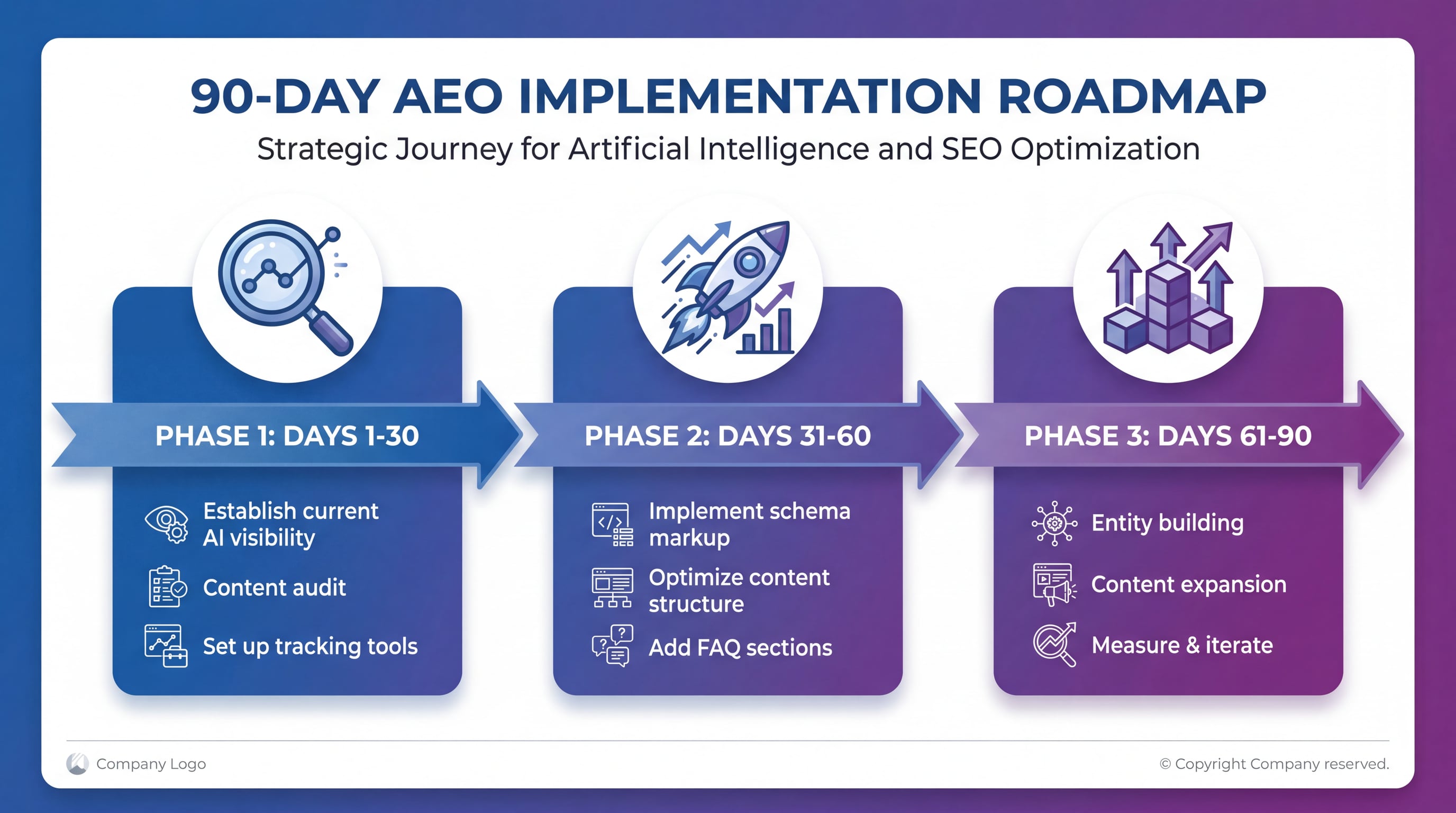
A structured 3-phase approach to implementing AEO over 90 days
Days 1-30: Audit and Baseline
Week 1-2: Establish Current State
-
Audit your current AI visibility (manually query ChatGPT, Perplexity, Gemini with your target keywords)
-
Document where your brand is cited, how it's described, and what competitors appear
-
Set up tracking tools (Semrush AI Toolkit or Otterly AI)
Week 3-4: Content Audit
-
Identify your top 20 pages by organic traffic
-
Evaluate each for AEO readiness (answer-first structure, schema markup, entity clarity)
-
Prioritize pages for optimization based on traffic value and AEO gaps
Days 31-60: Implement Quick Wins
Week 5-6: Schema and Structure
-
Implement FAQ schema on your top 10 pages
-
Add Organization and Article schema site-wide
-
Ensure all pages have proper heading hierarchy (H1, H2, H3)
Week 7-8: Content Optimization
-
Rewrite introductions on priority pages to answer-first format
-
Add "Quick Answer" sections at the top of long-form content
-
Create or enhance FAQ sections with common questions
Days 61-90: Build Long-Term Assets
Week 9-10: Entity Building
-
Claim and optimize Knowledge Graph presence
-
Ensure NAP consistency across all directories
-
Implement sameAs schema linking to social profiles
Week 11-12: Content Expansion
-
Create 5-10 new pieces of answer-first content targeting high-value queries
-
Develop comparison content (your brand vs. alternatives)
-
Publish original research or data that AI systems must cite
Week 13: Measure and Iterate
-
Re-run AI visibility audit
-
Compare baseline to current state
-
Identify what worked and double down
The Ongoing Process
AEO isn't a one-time project—it's an ongoing practice that should be integrated into your content workflow:
-
Every new piece of content: Structure for answer-first format from the start
-
Monthly: Track AI visibility and citation quality
-
Quarterly: Audit top pages for AEO optimization opportunities
-
Annually: Comprehensive entity and schema audit
The brands that treat AEO as a continuous practice rather than a one-time initiative will build compounding advantages over competitors still focused solely on traditional SEO.
Conclusion: Adapt or Become Invisible
The shift from SEO to AEO represents the most significant change in digital visibility since Google's PageRank algorithm launched in 1998. The fundamental question facing every business in 2026 is no longer "How do we rank higher?" but rather "How do we get cited by AI systems that are answering our customers' questions?"
The data is unambiguous: zero-click search is the new normal, AI-powered answer engines are fragmenting the search landscape, and traditional ranking positions deliver less value as users get their answers without clicking. Yet the majority of businesses are still optimizing exclusively for a model that's rapidly becoming obsolete.
The good news: AEO doesn't replace SEO—it builds on it. The technical foundations, content quality standards, and authority-building practices that made you successful in SEO remain essential. AEO adds a new layer focused on citation-readiness, answer-first structure, and AI-system trust signals.
The brands that will thrive in this new paradigm are those that:
-
Measure what matters: Track AI visibility alongside traditional SEO metrics
-
Optimize for both: Maintain SEO fundamentals while implementing AEO best practices
-
Think multi-surface: Optimize for the fragmented landscape of AI answer engines, not just Google
-
Prioritize trust: Build E-E-A-T signals that make AI systems confident citing your content
-
Stay agile: The AI landscape evolves rapidly; what works today may need adjustment in six months
The paradigm shift is here. The question isn't whether to adapt—it's how quickly you can move. Your competitors are already optimizing for AI visibility. Your customers are already getting answers from ChatGPT and Perplexity. The only question that remains is: Will your brand be part of those answers?
Key Takeaways
✅ 58.5% of searches now end without a click—AI answers are replacing traditional search results
✅ AEO is not a replacement for SEO—it's a complementary layer that builds on SEO fundamentals
✅ Citation is the new ranking—being mentioned in AI answers matters more than position in a list
✅ Answer-first content structure is the single most important AEO tactic
✅ Schema markup and entity clarity help AI systems understand and cite your content
✅ Multi-format content (especially video) dramatically increases AI visibility
✅ Only 14% of marketers track AI visibility—early movers have a massive advantage
✅ The future is agentic—AI agents will soon perform tasks, not just answer questions
Recommended Resources
Want to dive deeper into AI tools and optimization strategies? Visit TopAITools4U to explore:
-
16 curated categories of AI tools for every business need
-
Daily updates on the latest AI tools and features
-
Expert reviews and comparison guides
-
Practical tutorials for implementing AI in your workflow
Whether you're looking for AI presentation tools, SEO automation, content generation, or any other AI-powered solution, TopAITools4U helps you discover and evaluate the best tools for your specific needs.
About This Report: This analysis is based on industry data from Gartner, Semrush, Goodfirms, HubSpot, and leading AEO practitioners as of June 2026. All statistics and citations are sourced from publicly available research and industry reports.