
An AI research assistant can help organize a reading project, but its answer is only as useful as the evidence you can inspect. Before relying on a research brief, check that the cited papers exist, support the specific statement, and fit the question you intended to ask. A long reference list does not establish that the reasoning is sound.
This guide proposes an evaluation for literature discovery and evidence organization. It draws on current official product information without presenting a hands-on benchmark. It does not evaluate a clinical question, offer professional advice, or claim that a small pilot establishes the completeness of a research review.
Give the AI research assistant a bounded question
Write the research question in terms another reader could apply consistently. Define the subject, comparison if relevant, outcome of interest, and any period or context restrictions. A vague request for everything about a field invites a broad narrative that may be difficult to check.
Decide what counts as relevant before reading the generated answer. You might require a certain type of study, a defined setting, or a particular kind of measurement. The criteria should follow the project, not whichever papers the tool happens to surface first.
Keep a note of those choices with the query. If you revise the scope later, record why. This makes it easier to tell whether a changed conclusion reflects new evidence or merely a different question.
Compare literature search with evidence extraction
Elicit presents assistance with finding academic papers and organizing research evidence. It is a candidate for evaluating literature search and structured review support. Confirm current source coverage, access requirements, and export options for the workflow you plan to use.
The site's Elicit listing can help you begin a shortlist. The research category covers adjacent products, but a shared category does not mean the tools use the same databases or apply the same screening process.
Separate finding papers from extracting claims. A relevant paper can be summarized poorly, and a polished extraction can come from a paper outside your scope. Test both stages rather than treating a readable final report as proof that the preceding search was adequate.
Start with sources you already understand
Choose a few papers whose relevance and main findings you can inspect yourself. Include a clear match, a superficially related paper that should be excluded, and a source with an important limitation. This is a proposed pilot set rather than a representative benchmark of the whole literature.
Ask the tool to explain why each source belongs in the review. Compare its reasoning with your inclusion criteria. Where the abstract does not establish an answer, record that gap instead of treating a plausible inference as a reported result.
Check what the system actually had access to. A conclusion drawn from an abstract is different from one grounded in the full paper. The review notes should make that distinction visible so the next reader knows what still needs inspection.
Perform citation checking at the claim level
For each important statement, open the cited source and locate the supporting passage. Confirm the title, authors, and version before deciding that a link is correct. Similar titles or a reference to a related paper can make an answer look sourced while leaving the claim unsupported.
Read beyond the highlighted sentence. Determine whether the authors reported an observation, proposed an explanation, or described prior work. Preserve uncertainty and qualifications when transferring the statement into your own notes. A citation should support the wording you actually use.
If the source cannot be accessed, mark the claim as unverified. Do not replace the missing check with confidence in the surrounding report. You may still retain the paper as a candidate for later reading, but it should not quietly become established evidence in the conclusion.
Build an evidence table before writing a synthesis
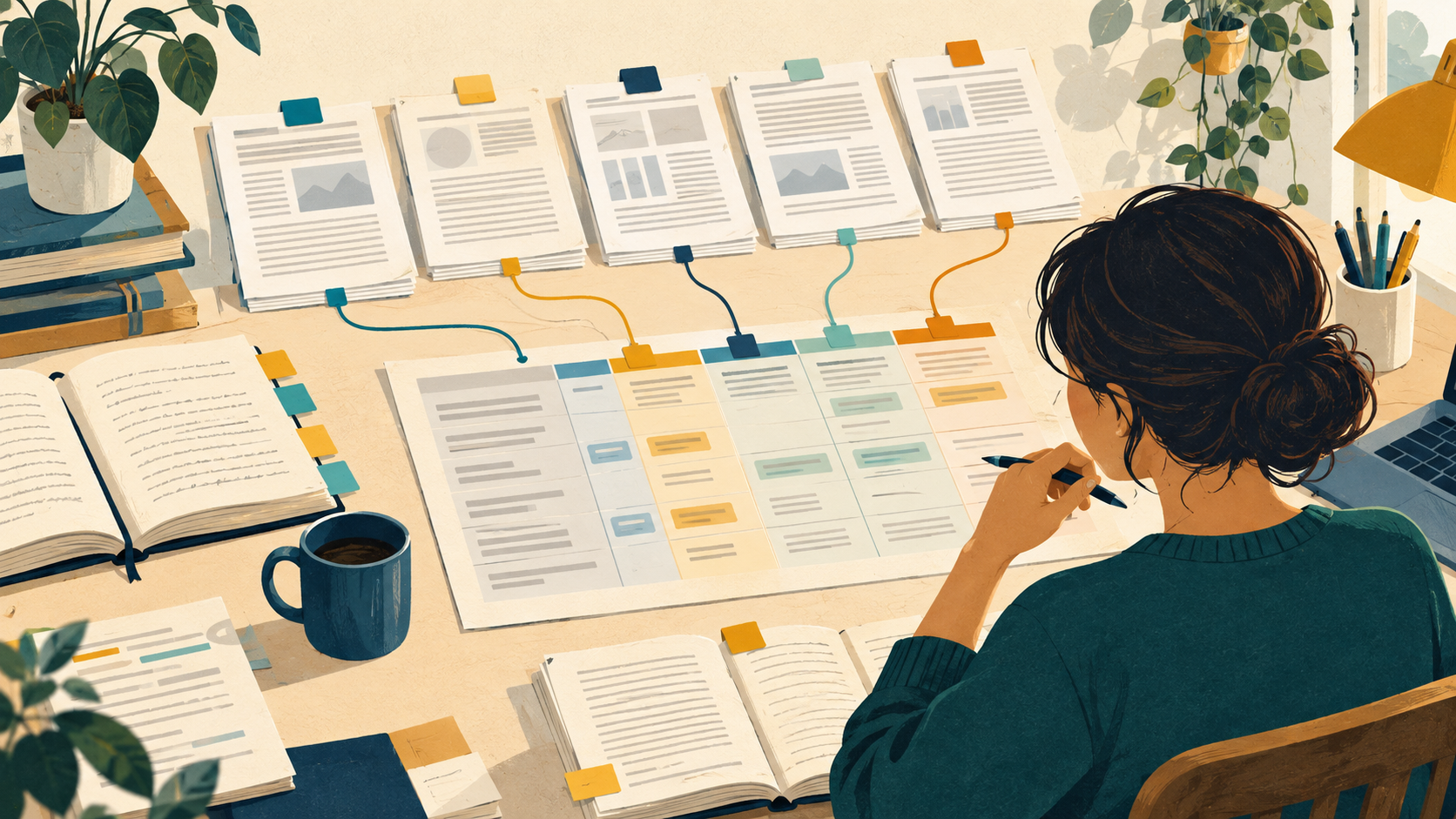
Use an evidence table with the research question, source, relevant passage, finding, limitation, and review status. Adjust the columns to the project rather than filling a generic template with whatever information is easy to extract. Keep quotations and paraphrases distinguishable.
Compare sources on compatible terms. Different settings, definitions, or measurement periods may explain a disagreement. Do not turn those differences into a simple vote count in which more papers automatically make a claim stronger. Record the reason a result applies or does not apply to your question.
Write the synthesis after reviewing the table. Distinguish an author's finding from your interpretation across several sources. If evidence is mixed or the search was limited, say so directly. A useful summary can identify a remaining question without pretending the review resolved it.
Test the handoff and the limits of the workflow
Export a small result and check whether another reviewer can open the sources, understand the screening decisions, and trace a key conclusion. Preserve the query, inclusion criteria, and review date with the output. A report that loses these details during export may be hard to maintain.
Before expanding, verify current usage limits, document handling, and access controls with the provider. Check how uploaded material is retained and whether a team can use the workflow under its own policies. This article does not assume a particular plan offers every review or collaboration feature.
Keep human responsibility for the final claims. An assistant can organize work, but the author still needs to decide whether the evidence justifies the language used. For projects requiring a formal review method, follow the appropriate method rather than treating this pilot as a substitute.
FAQ
Does a real citation prove that the sentence is supported?
No. Open the source and inspect the relevant passage. The cited paper may exist while addressing a different question or making a more qualified claim.
Is abstract-only access always sufficient?
It depends on the task. Record the access limitation and inspect the full text when the claim requires details not established in the abstract.
Should I expect one search to find all relevant work?
Do not assume completeness. Record the search scope and check coverage against the needs of your project, especially when a formal or comprehensive review is required.
Conclusion
Choose an AI research assistant through the evidence you can trace and the review decisions you can explain. Use citation checking, maintain an evidence table, and preserve the distinction between findings and interpretation. The best handoff lets another reader inspect how the conclusion was reached.