
This Descript review looks at a specific buying decision: whether editing spoken media through a transcript fits the work your team actually produces. Descript is worth investigating when the words carry the story and several people need to discuss revisions. Its fit becomes less obvious when the central decisions concern motion, compositing, or precise visual timing rather than the spoken argument.
This is a documentation-based product analysis using official information checked on November 9, 2026. No recording was edited for this review. There are no independent accuracy scores, listening tests, or measured production savings behind the recommendations.
Descript review verdict: strongest when the spoken story leads
Descript's official product page presents video editing through a document-like experience, multitrack podcast editing, transcription, captions, and recording. That combination makes it a relevant candidate for interviews, explanatory recordings, and recurring spoken content. These are provider-described capabilities, rather than proof that every source recording will behave equally well.
The recommendation is conditional: shortlist it when the edit starts with deciding what someone should hear. A producer removing an irrelevant answer or moving an explanation has a clear relationship between the words and the intended result. A designer building a sequence around visual rhythm may have a different starting point, even if the project also includes speech.
This distinction matters more than the length of the feature list. A tool can offer many ways to change media while still fitting some editorial decisions better than others.
Transcript editing makes the argument visible
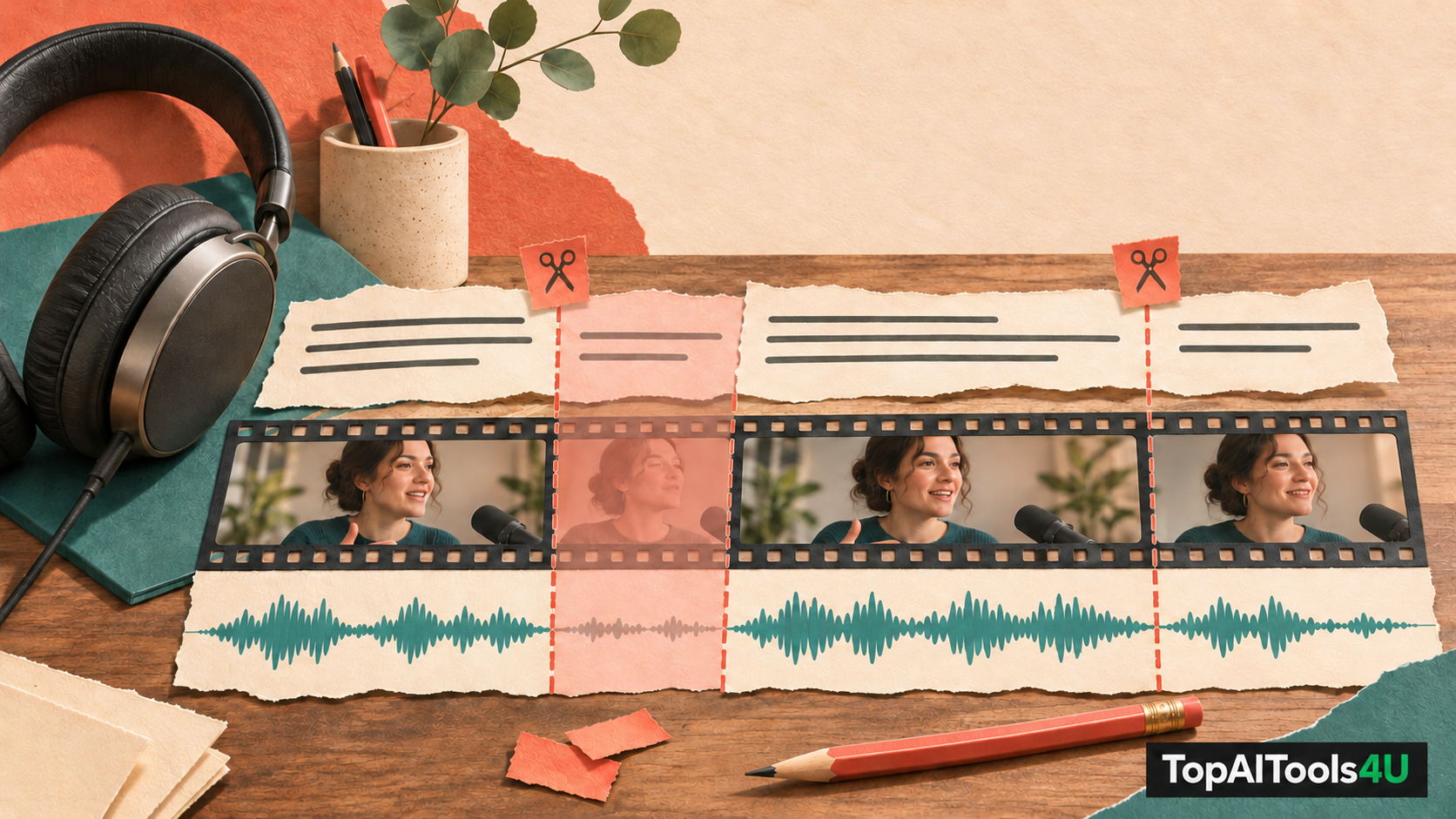
A transcript gives collaborators something concrete to discuss before they debate the final export. In a hypothetical customer interview, the editor might retain a qualification that makes the answer longer but prevents an exaggerated claim. A colleague reading the text can question that decision without needing to describe an uncertain point on a timeline.
That is the appeal of transcript editing: language becomes part of the editing surface. It does not follow that reading the text is enough. Hesitation, emphasis, and the transition between two answers can change the meaning of an apparently clean sentence.
For a team reviewing sensitive wording, the written version can support discussion while the audio remains the record that must be heard. The buyer should value both parts of that relationship. An attractive text workflow is less useful if nobody owns the final listening decision.
Podcast production still needs a listening judgment
The homepage lists tools for removing filler words, enhancing sound, and regenerating speech. Each describes a possible intervention in the recording. This review does not rate their output or adopt the provider's claims about realism, accuracy, or speed.
A pause may be unnecessary dead time, or it may communicate uncertainty that belongs in the interview. A repeated word might distract from an explanation, while another repetition provides emphasis. The same automatic operation can therefore have different editorial consequences depending on the passage.
For podcast production, the useful question is whether the product makes these choices easier to inspect and revise. Counting the number of possible corrections says little about the quality of the finished conversation. Listening after a consequential change remains part of the work, rather than a failure of automation.
Video revisions introduce another layer of review
An edit that reads naturally can still produce an awkward visual change. Consider a presenter moving a hand while finishing a sentence. Shortening the sentence may improve the explanation while making the transition more noticeable. That example is an editorial possibility, not a result observed in a Descript test.
The platform's product breadth makes video revisions a reasonable buying topic, but the review cannot establish frame-level behavior from a homepage. Teams with demanding visual requirements should examine their actual material and delivery constraints before committing a production process.
A recurring training clip and a carefully choreographed commercial should not inherit the same recommendation simply because both contain narration. The first may be organized around maintaining the explanation; the second may be organized around a planned visual performance.
The handoff can matter as much as the first edit
Media production often has several owners: someone supplies the recording, someone changes it, and someone approves the finished message. The practical value of a transcript-centered product depends partly on how those people understand the current version.
Imagine an internal announcement whose wording changes after approval. The production team needs to identify the revised passage and confirm the resulting media, not merely circulate a new paragraph. A written review surface can help frame that discussion, but this analysis does not assume an automatic approval system or a particular versioning entitlement.
The Descript catalog entry is a starting point for discovery. For a purchase decision, follow through to the provider's current documentation on account access, supported delivery, and the features included in the intended plan.
Who should shortlist it, and who should look more closely
An interview producer, educator, or small content team has a clear reason to investigate the product when spoken explanations dominate the schedule. The argument is particularly understandable when colleagues already review scripts or transcripts and need a closer connection to the media.
A team whose work depends on specialized visual finishing should examine fit more carefully. This does not claim that Descript lacks visual tools. It means the buying argument in this review comes from the transcript-to-media relationship, not an independent assessment of every production capability.
No current price is quoted here. Subscription value depends on the actual plan, usage allowances, required collaborators, and delivery obligations. Those details should come from current provider information rather than an old comparison copied into a new review.
FAQ
Was Descript tested for this review?
No. The analysis uses official product descriptions and editorial reasoning. It does not report a hands-on edit, transcription benchmark, or audio comparison.
Is a correct transcript enough to approve an edit?
No. A transcript can omit the significance of pacing, emphasis, or a visual transition. The finished media needs its own editorial review.
Is Descript only relevant to podcasts?
The official page also describes video editing, recording, and captions. This review concentrates on spoken content because that provides a clear basis for judging buyer fit.
Conclusion
The case in this Descript review is straightforward: investigate the product when the spoken story drives production and a transcript helps people discuss the edit. Keep the listening and visual decisions visible in the buying process. The strongest fit connects written revisions to finished media without treating either one as a substitute for the other.