
This Murf AI review favors a defined use: a team has approved words and needs a maintainable way to turn them into narration. Its appeal is the relationship between the script, delivery choices, and the audio that leaves the production process. That is a more precise reason to consider a voice platform than a general wish for speech that sounds impressive.
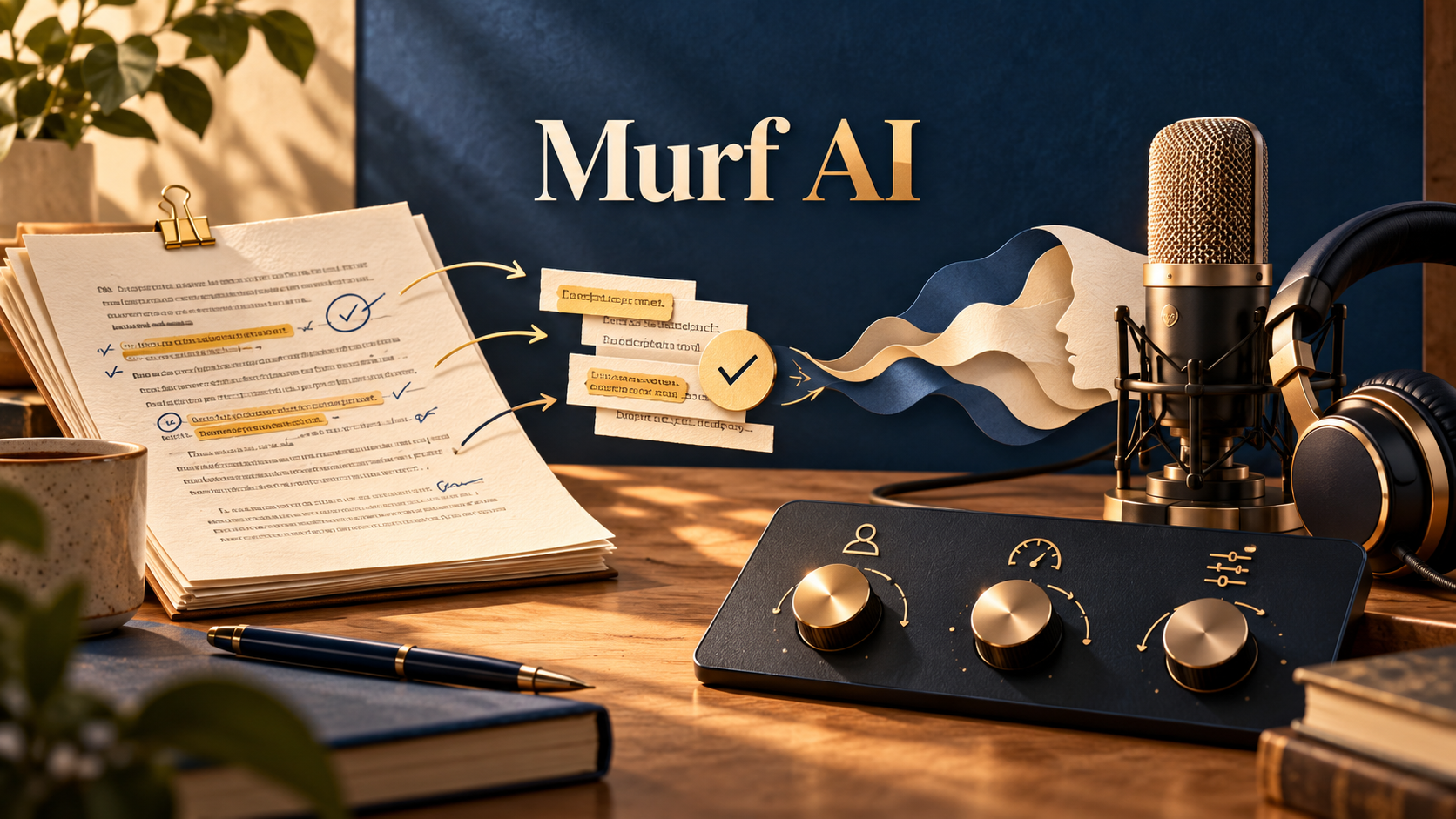
Original editorial illustration; no product screenshot or measured result is shown.
This analysis uses official product descriptions checked on October 29, 2026. It is a documentation-based review, with no hands-on listening comparison, pronunciation score, or measured savings. The judgments concern buyer fit and the continuing responsibilities around a generated voiceover.
Murf AI review verdict: a coherent case for repeatable narration
The clearest shortlist case is recurring narration in which the written message has an owner. A lesson introduction, product explanation, or updated instruction may need a consistent production path even when only a few sentences change. The value is the ability to treat wording and delivery as related decisions rather than unrelated files.
Murf's text-to-speech page describes converting scripts and documents into speech, adjusting delivery, previewing the result, and exporting audio. These provider-described capabilities support the product's relevance to voiceover production. They do not establish the quality of a particular voice or a guaranteed result for every script.
Our recommendation is therefore conditional. Consider the product when narration is a recurring responsibility and the team wants to retain clear ownership of the message. The case is weaker when the actual need is a specialist audio-performance tool, a one-off experiment, or a production process that depends on a particular human performance.
The approved script gives revisions a reference point
A script-centered process has a practical advantage: colleagues can discuss the message before discussing how it sounds. A correction to terminology, a revised product detail, or a changed instruction can be identified in the written asset. That gives review a reference point beyond a series of exported audio versions.
Consider a hypothetical training team updating an explanation after a process changes. Its problem is not simply generating another voice. It must preserve the approved meaning, identify which sentence changed, and ensure the new audio reaches the correct lesson. This scenario illustrates the production role assessed here; no such project was completed for the review.
The limitation is that written approval does not automatically approve spoken delivery. A pause, emphasis, or reading of a name can change how a sentence is understood. Keeping the script visible helps organize the work, while listening remains a separate creative and editorial responsibility.
Delivery controls matter when they support a decision
The official page describes adjusting speed and tone and previewing the audio. Those controls give the buyer a concrete part of the product to investigate. Their presence is more relevant than a vague claim that every generated voice is indistinguishable from a person, which this review does not adopt.
The useful question is what the creator needs to direct. A calm explanatory passage and a short attention-grabbing message may require different pacing. A narrator can sound fluent while placing emphasis in a way that weakens the intended instruction. Controls are valuable when they help address such decisions rather than simply expanding the list of settings.
No outputs were listened to for this article. That leaves the behavior of names, specialist vocabulary, long passages, and language-specific delivery unresolved for the reader's material. A favorable view of the product's organizing idea should not be mistaken for evidence that those requirements have already been satisfied.
The Studio proposition is distinct from a speech integration
The Murf homepage currently places Studio alongside APIs and conversational-agent products. That broader scope matters because the same provider can serve different kinds of buyers. A creator producing reviewed audio and a developer operating a speech-enabled application have related technology needs but different definitions of success.
For the creator, the important object may be an approved voiceover file and the script that explains it. For the developer, the important object includes the continuing behavior of speech inside an interaction. Availability, response behavior, and the handling of application failures become part of that second responsibility.
This review focuses on narration production. It does not rank API latency, certify an integration, or imply that the broader product family is included in every subscription. A buyer should compare the specific product path it intends to use rather than inheriting conclusions from a different use case under the same brand.
The handoff is part of the product's practical value
An export is useful only when the receiving person knows what it represents. A finished clip may need an approved script version, a destination, and a clear relationship to the other material in the project. Without that context, convenient generation can leave a team with more audio and less certainty about which file to use.
The strongest fit is a team willing to maintain that relationship. A platform can make narration accessible without deciding which version belongs in a published lesson or campaign. The continuing effort includes script ownership, listening review, revision decisions, and a sensible place for the final asset.
Current plans, limits, output formats, and terms for intended uses should be checked with Murf. This review makes no price, ownership, or commercial-entitlement guarantee. Our Murf catalog listing is a starting point for discovery, while the buying case belongs to the actual production responsibility.
FAQ
Is this Murf AI review based on a controlled listening test?
No. It analyzes official product descriptions and gives a conditional view of buyer fit. It does not report measured naturalness, pronunciation accuracy, or editing speed.
Does an approved script make the audio automatically ready?
No. The spoken delivery still needs review. Meaning can depend on pacing, emphasis, and the way the intended wording is read.
Is the narration product the same decision as a speech API?
They are different buying responsibilities. Producing a reviewed asset and operating speech inside an application require overlapping but distinct evaluations.
Conclusion
This Murf AI review supports a specific fit: maintainable voiceover production built around an approved script. Delivery controls and a clear handoff can serve that role, with actual sound quality still to be established for the intended material. The stronger purchase follows a recurring narration responsibility and a team prepared to own the result.