
This Perplexity review recommends separating two buying questions: do you need a sourced answer, or do you need software to carry a task through several tools? Perplexity's current product family addresses both, but the value proposition changes between Search and Computer. Treating them as one indistinguishable assistant makes the purchase harder to judge.
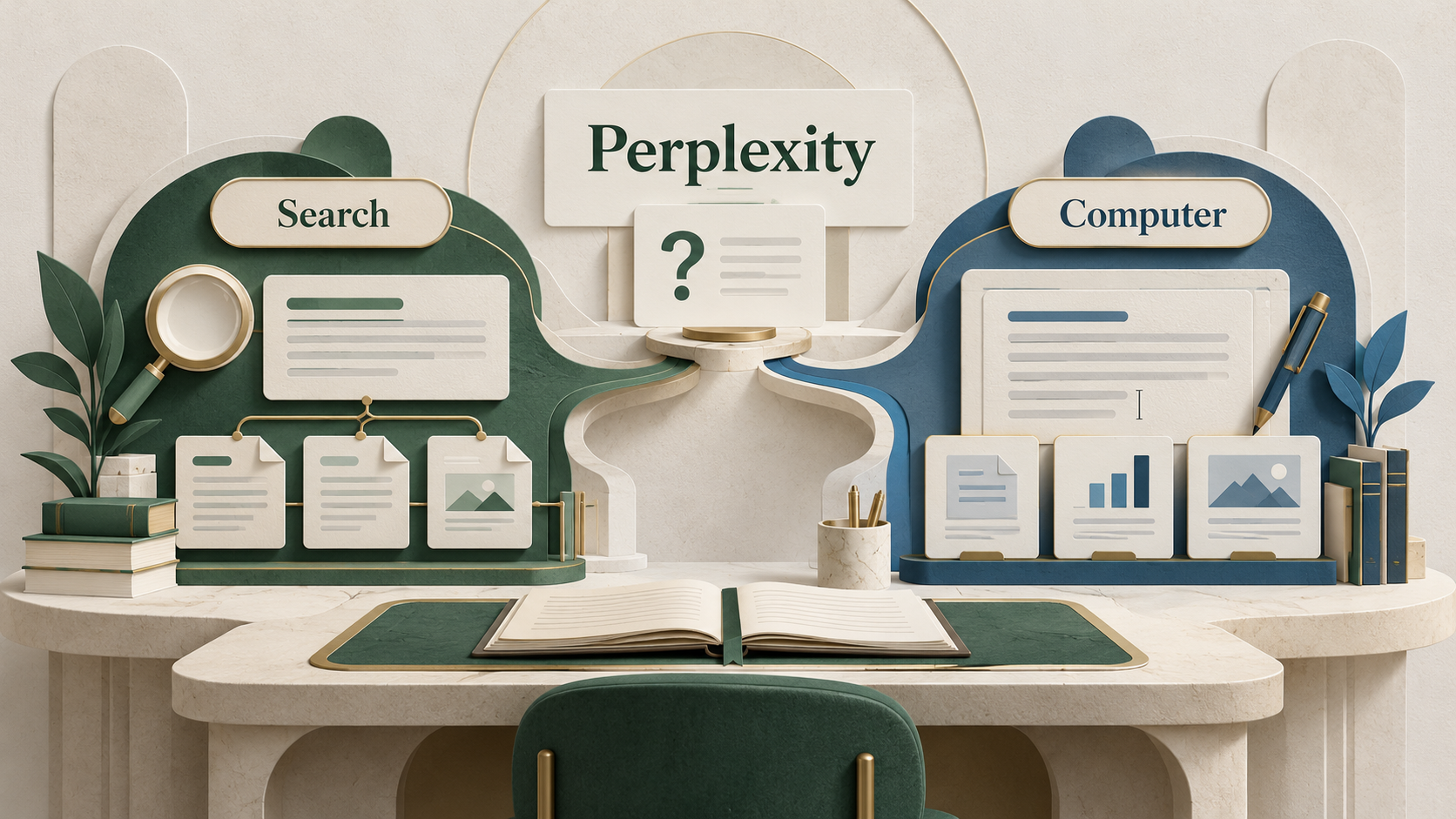
Original editorial illustration; this is not a product screenshot or a measured result.
This is an analysis of official materials checked on October 27, 2026. It contains no hands-on source-accuracy score, measured productivity gain, or comparison of paid model outputs. The editorial judgments concern the product's role in a team and the limits of what public descriptions establish.
Perplexity review verdict: strongest when the answer has a destination
The most persuasive reason to consider Perplexity Search is a recurring need to reach a usable explanation with visible routes back to sources. A reader can ask a focused question, explore a topic, and decide which evidence deserves closer attention. That is a concrete job rather than a broad ambition to add AI to everything.
The official Search versus Computer overview describes Search as an answer-oriented product and Computer as a platform for work spanning multiple steps and connected tools. This distinction is useful even before considering individual features. It identifies whether the expected endpoint is understanding or a completed deliverable.
Our assessment favors Search for an analyst or operator whose immediate output is a brief answer that can be investigated. Computer belongs on a different shortlist when an ongoing task needs files, applications, or repeated execution. The second decision carries a broader operating commitment than the first.
Clickable sources are part of the interface contract
The same overview describes cited web responses. Perplexity's enterprise query introduction also explains that users can inspect sources associated with sections of an answer. This makes source access part of the product experience rather than an optional bibliography added after the discussion.
That arrangement is valuable when a reader needs to move between a concise account and the material behind it. For example, a team comparing several suppliers can use an answer to identify the claims worth examining. This is an illustrative decision context, not a supplier investigation conducted for the review.
The limitation is equally concrete: opening a citation can reveal that the source supports only part of a sentence. A visible source makes that problem discoverable. It does not prove that the answer selected the best source, interpreted it fully, or represented the entire range of relevant views.
Follow-up questions make discovery conversational
A question rarely arrives fully formed. A buyer may begin with a broad topic, discover that two options address different jobs, and then need a narrower explanation. The enterprise introduction describes follow-up questions, source selection, and ways to share or export the resulting work. These documented functions explain why the product can serve as a continuing inquiry rather than a single search box.
Follow-up questions keep the inquiry moving. A useful response can expose the next uncertainty without forcing the reader to reconstruct the whole problem. The reader still needs enough subject understanding to recognize when the inquiry has become too narrow or inherited a mistaken premise.
That matters for evaluating ease of use. A conversational interface can reduce friction at the start of a task while leaving the hard judgment untouched. This review does not equate easy question entry with consistently correct research or infer that one model option performs best for every reader.
Search and task execution deserve separate expectations
Computer's documented role includes work across sources and tools, with artifacts that can continue into a team's process. That expands what success means. A good explanation must be understandable; a completed artifact also needs to fit its destination, retain the relevant context, and remain usable by the people receiving it.
The distinction gives a buyer a cleaner way to allocate responsibility. Someone who only needs a one-time cited answer may not need to organize a connected production process. A team seeking recurring deliverables needs to decide who reviews the outputs and maintains the task when the underlying information changes.
This is an interpretation of product scope, not a report that either workflow succeeded or failed in testing. The useful purchasing principle is to define the endpoint before comparing the size of the feature list. Otherwise a more extensive product can look like better value while serving a job the team does not have.
The limits that remain after a useful answer
Perplexity can organize access to information without becoming the authority behind every source it finds. A publisher's date, the context of a quotation, and the completeness of an account still matter. Important claims may require reading the primary material or seeking evidence beyond the generated answer.
Account-level access also matters. Premium sources, connectors, export behavior, and execution features should be confirmed for the proposed subscription. This review does not assume that the capabilities described across enterprise and product-family pages are included in every account or that a general feature description guarantees a particular integration.
The Perplexity catalog entry is a place to begin discovery. The buying case is strongest when the team can name the output it needs, explain how sources will be reviewed, and distinguish answer discovery from task execution. That is a more durable basis for evaluation than a universal assistant ranking.
FAQ
Is this Perplexity review a test of factual accuracy?
No. It is a documentation-based product analysis. It discusses the value and limits of source visibility without assigning an independently measured accuracy rate.
Are Search and Computer the same buying decision?
They can serve related work, but the documented emphasis differs. Search centers on cited answers; Computer addresses tasks that span multiple steps, tools, and deliverables.
Does a citation make a generated answer ready to publish?
Not automatically. The source must support the wording, and the proposed use may require additional context or checking. A source link helps that review happen.
Conclusion
This Perplexity review favors a specific fit: cited answer discovery when the reader needs an explanation they can pursue into its sources. Computer deserves separate consideration when execution becomes the job. In either case, the better purchase begins with an intended output and a clear owner for deciding whether the result is ready to use.