

Search for “selling AI websites Reddit,” and you will find a familiar mix of beginner questions, confident success stories, and skeptical replies.
Some people want to know how to land their first local business client. Others claim they are selling multiple websites a week. Experienced developers question whether beginners can deliver something reliable after generating a few attractive pages.
There is a useful business idea underneath the noise: use AI to help build websites, then charge for the judgment, customization, and ongoing work that make those websites useful.
But turning that idea into a sustainable service takes more than choosing a builder. This guide examines three Reddit discussions and develops a practical approach to finding clients, creating a clear offer, pricing your work, and delivering websites worth paying for.
What the Reddit Discussions Actually Tell Us
The three threads raise different questions. Read together, they provide a better starting point than any single success story.
Beginners need a focused offer
In “Selling website for local businesses,” the original poster asks whether to specialize in an industry, stick to informational websites, or move into Shopify. Replies emphasize understanding client problems, learning website fundamentals, and choosing a niche.
Those are useful questions to answer before buying another subscription. A restaurant menu website and an online store require different sales conversations, testing, and maintenance.
People report sales, but the evidence is anecdotal
The thread “Did anyone actually make money selling AI websites?” includes self-reported client wins and discussion of cold calling, pricing, and business outcomes.
These accounts suggest possible approaches. They do not establish typical earnings, average conversion rates, or what a beginner should expect to make.
Strong headlines deserve closer scrutiny
In “Developers Hate AI. I Used It To Sell 10 Websites This Week,” the author describes identifying existing website problems, contacting owners, and presenting redesigns. Commenters also question the promotional nature of the post.
The workflow is worth considering independently. The sales claim remains unverified.
The practical lesson across these discussions is straightforward: examine the process behind a claim before treating the claimed result as a realistic target.
Can You Make Money Selling AI Websites?
You can offer paid website services while using AI during production. Whether the work becomes profitable depends on what clients pay, how much time you spend, and what it costs to deliver and support each project.
A business owner may need help clarifying services, organizing information, connecting a booking tool, or replacing a confusing mobile layout. Generating a first draft addresses only part of that work.
Consider a hypothetical cleaning company. Its current website has vague service descriptions, no clear service area, and a contact form that nobody checks.
A useful redesign would explain what customers can book, where the company operates, and how to request an estimate. It would also send inquiries somewhere the owner actually monitors.
That is a concrete service you can discuss and demonstrate. Promising more revenue before you have evidence would go further than the work supports.
Your offer should describe the improvements you control and explain how the client can assess their value after launch.
Choose One Type of Local Business First
For a beginner, a narrow market makes research and delivery easier.
You might start with residential cleaners, landscapers, mobile detailers, photographers, or independent repair businesses. Choose a category you can understand and reach.
Then study how customers make decisions in that category:
- What information do they need before contacting the business?
- Do they want a quote, an appointment, or an immediate phone call?
- Which questions repeatedly delay a purchase?
- What evidence helps them trust the provider?
- Who will update the website after launch?
A mobile detailer may need clear packages, service boundaries, and a booking path. A photographer may need galleries and inquiry forms organized by session type.
Those differences should shape your offer.
Start with a project you can support confidently. An informational website with a tested inquiry form is a more manageable first assignment than a custom store with payments, inventory, customer accounts, and refund workflows.
Expand when you understand the additional responsibilities.
Build an Offer With Clear Boundaries
“AI website creation” describes your production method. A prospective client needs to understand what they receive.
For example:
A five-page website for local cleaning businesses, including service descriptions, service-area information, a quote request form, mobile layout review, and launch support.
Make the boundaries equally clear. Specify who supplies photography, how many revision rounds are included, which integrations you will configure, and when the project counts as complete.
A useful proposal should cover:
| Item | What to clarify | |---|---| | Pages | Names and purpose of included pages | | Content | Who supplies and approves copy and images | | Functionality | Forms, booking links, payments, or other agreed features | | Revisions | Included rounds and how feedback is collected | | Launch | Domain, hosting, access, and approval responsibilities | | Support | Included period and arrangements afterward |
This prevents a small project from quietly becoming an unlimited redesign service.
It also gives the client a fair way to compare your proposal with other options.
How to Find Your First AI Website Clients
Look for a visible problem you can explain accurately.
Review businesses in your chosen niche and record specific observations: a broken contact link, an unreadable menu, outdated opening hours, or a booking button that is difficult to find on a phone.
Avoid treating personal taste as evidence. A design can look old and still serve its customers well.
Start conversations around the issue you actually observed. For example:
Hi Alex, I noticed your mobile contact page makes visitors scroll past several sections before they reach the estimate form. I have an idea for making that path clearer. Would a short walkthrough be useful?
This is an illustrative outreach message, not a claim about guaranteed response rates.
Keep your research manageable. A simple list of business names, observed issues, contact dates, and replies is enough to begin learning which problems owners care about.
Qualify interest before building a full demo
Before investing hours in a redesign, ask what the owner wants to improve, whether the website is a current priority, and who approves the purchase.
A prospect who likes a free preview may still have no intention of buying.
Use a brief audit or one sample section to support an initial conversation. Build a larger prototype when there is enough interest and an agreed reason to proceed.
That keeps your time available for serious opportunities.
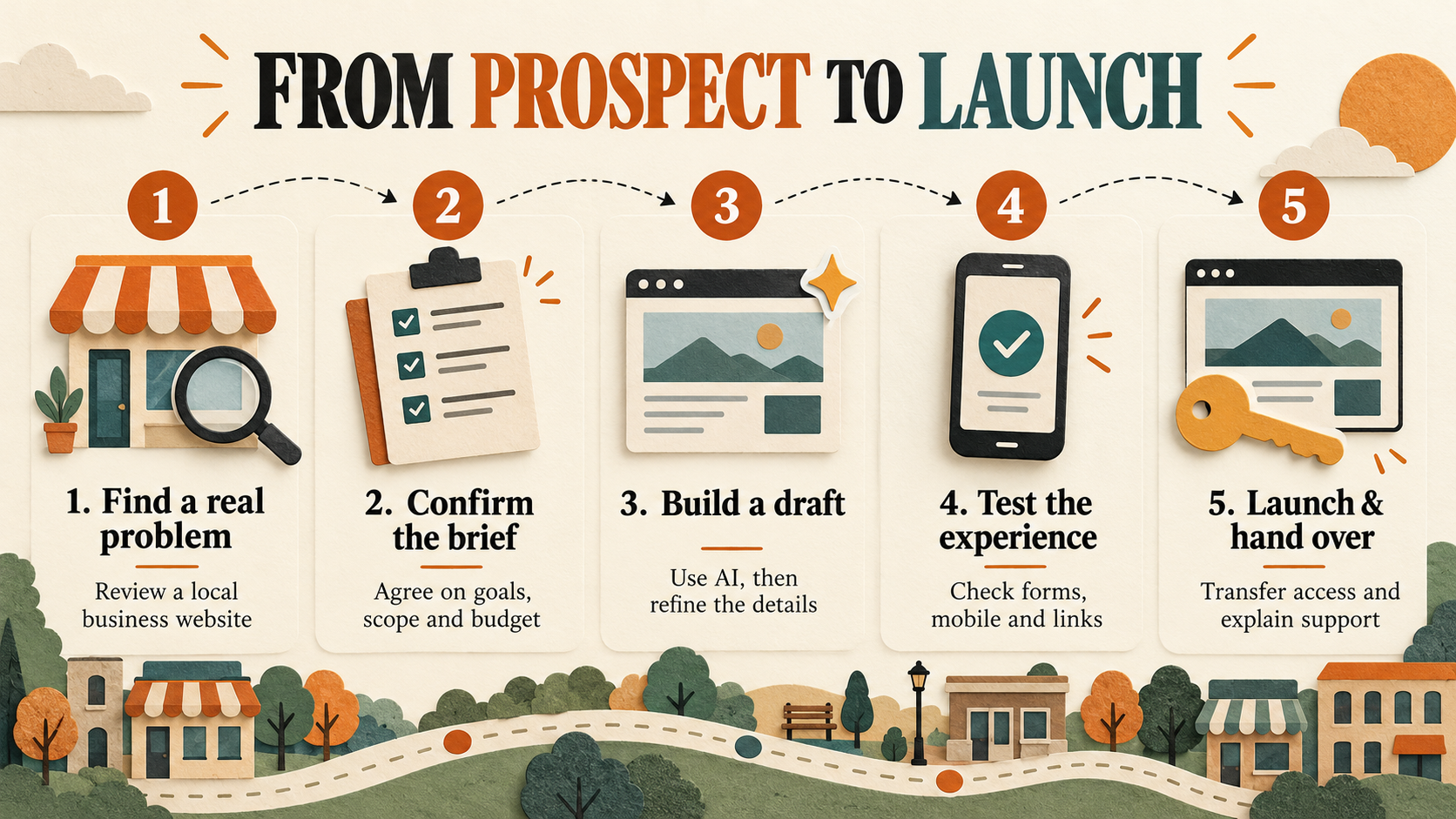
Move from a specific business problem to a tested website, with scope and responsibilities agreed before the build.
Where AutoCoder Fits Into the Workflow
Once you have a clear brief, an AI builder can help you turn it into something the client can review.
AutoCoder is one option to evaluate for this stage. Its official website describes website generation from Google Maps business links, visual editing, and project code export. These capabilities are relevant to a local business workflow: starting from existing business details, refining a draft, and considering how the project will be maintained or handed over. Source: AutoCoder’s official website.
For example, you could use a prospective client’s business listing as a starting point, then review the generated details with the owner. Confirm services, opening hours, contact information, and the intended customer action before treating the draft as ready.
Public information still needs checking. A listing may be incomplete, and an AI-generated page may introduce wording the business has never approved.
When testing autocoder.cc or another builder, use a small representative project. Check how easily you can revise layouts, connect the required services, and manage the finished site. Confirm current plan limits and commercial terms before including the tool in a client proposal.
The useful question is whether it supports the service you have promised.
Use a Detailed Brief to Improve the First Draft
A vague instruction such as “make a professional cleaning website” leaves too many decisions unresolved.
A stronger brief includes the audience, services, location, page structure, tone, and primary action.
For example:
Create a mobile-friendly website for a residential cleaning company serving three nearby towns. Include Home, Services, About, Service Areas, and Contact pages. Prioritize quote requests. Use plain English and clearly distinguish recurring cleaning from one-time deep cleaning. Mark missing business details for review. Do not invent testimonials, certifications, prices, or guarantees.
Give the builder approved material whenever possible. Real service descriptions and authorized photographs provide a stronger foundation than generic filler.
Then review one part at a time. Check the structure first, followed by copy, layout, and functionality.
Trying to fix everything through one long prompt makes it harder to identify what changed and whether the result meets the brief.
Price the Whole Project, Including Your Time
Calculate pricing from the complete job rather than the time it takes to generate the first version.
Include discovery, outreach, writing, revisions, testing, launch work, and support. Account for tool subscriptions and other direct costs too.
Here is a hypothetical example, not a market benchmark:
You charge $900 for a website. Allocated project costs are $100, and the total work takes 20 hours. That leaves $800 before taxes and other business expenses, or $40 per hour.
If revisions push the project to 40 hours, the same amount becomes $20 per hour.
The example shows why scope and time tracking matter.
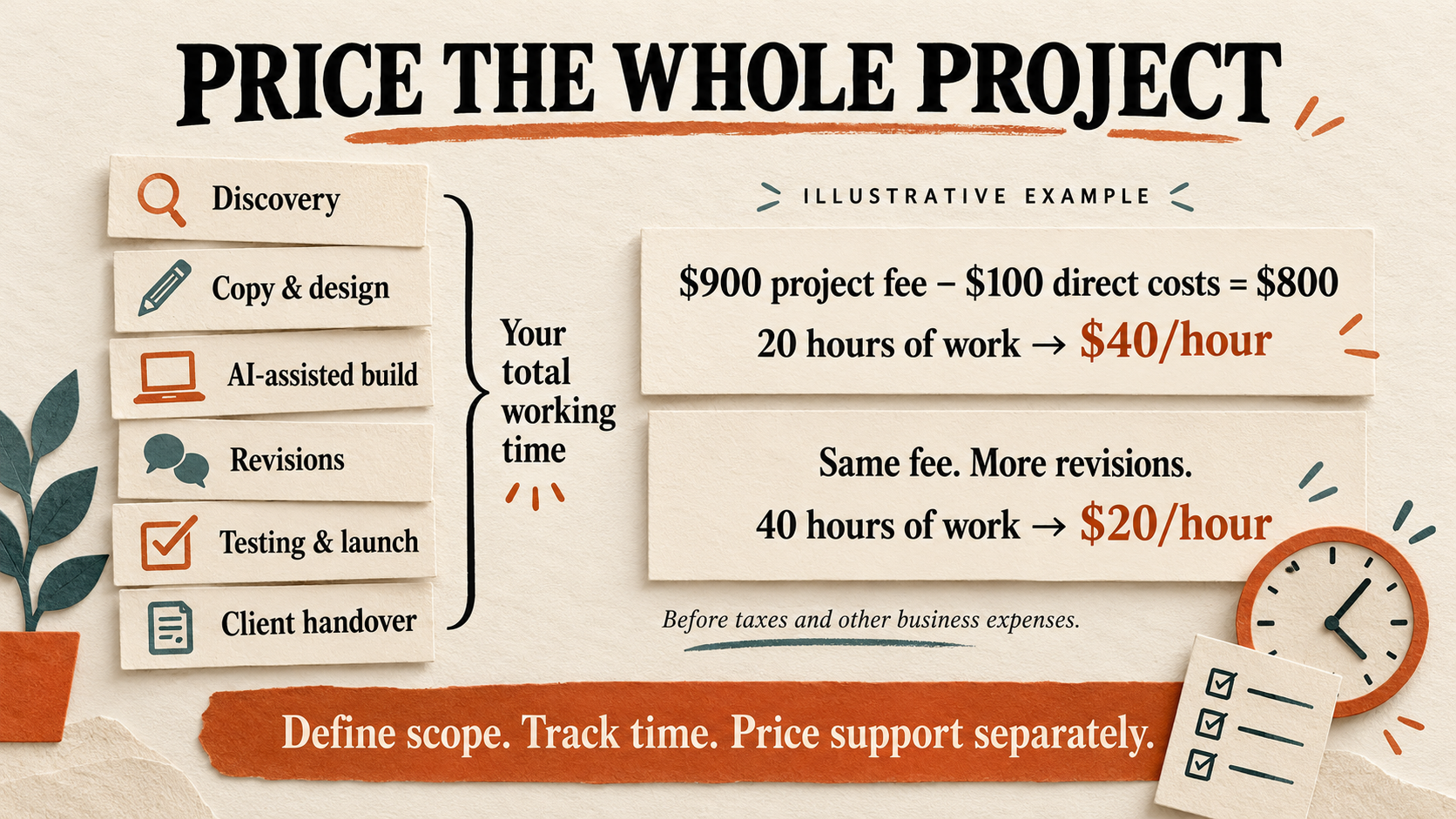
Hypothetical figures illustrate how extra revision time affects effective hourly earnings, before taxes and other business expenses.
You can offer ongoing maintenance when there is defined work to perform. Explain what the fee covers, such as a monthly allowance for content updates, form checks, or agreed technical maintenance.
Also document what happens when the arrangement ends. The client should understand who controls the domain, where the site is hosted, and which costs continue.
Recurring billing is easier to justify when the recurring service is clear.
Test the Website Before Asking for Final Approval
A polished preview does not prove a website works.
Test the tasks a customer is supposed to complete, using the actual published environment when possible.
For a local service website, review:
- Navigation and readability on several screen sizes.
- Phone, email, booking, and map links.
- Form submission, error messages, and delivery to the correct recipient.
- Business names, addresses, hours, and service descriptions.
- Keyboard navigation, visible focus, and form labels.
- Image loading and layout stability.
- Page titles, headings, and obvious placeholder content.
Check failure states as well. What happens when someone leaves a required field empty? Does a failed submission explain what to do next?
Ask the owner to complete the main customer task during review. Watching them request a quote or find a service can expose misunderstandings that a screenshot review misses.
Keep payment and account features within your ability to verify and support.
Plan the Handover Before Launch
The project should end with the client knowing how to use what they bought.
Provide a short handover covering account access, routine edits, inquiry handling, and support arrangements. Explain which changes the owner can make and which require help.
Confirm that domain and hosting responsibilities match the proposal. If you are managing accounts for the client, document the arrangement and the process for transferring control.
Agree on how problems will be reported after launch and what is included in the initial support period.
You can also establish a simple measurement plan. Depending on the project, that might involve tracking quote submissions or booking-link clicks. Define what is being counted so the client understands the report.
A clear handover reduces confusion and gives future maintenance work a sensible starting point.
Frequently Asked Questions About Selling AI Websites
Do I need coding skills to sell AI websites?
You need enough knowledge to evaluate the work, troubleshoot common problems, and recognize when specialist help is required. Your service scope should match what you can reliably deliver.
How much should I charge?
Base your quote on scope, total working time, direct costs, support obligations, and the client’s requirements. Reddit prices are individual reports, not dependable benchmarks.
Is cold calling better than email?
The Reddit threads do not establish a universal winner. Test an appropriate channel with a focused audience and track useful conversations, proposals, and paid projects.
Can I use AutoCoder for local business projects?
Its official site describes features relevant to that workflow. Test your intended project, verify current terms and limits, and confirm that the finished result meets the client’s requirements.
Start With One Project You Can Deliver Well
The “selling AI websites Reddit” conversation is useful for discovering questions and possible approaches. It offers much weaker evidence for predicting income.
Begin with one business category, one clear offer, and a project small enough to test thoroughly. If you want to evaluate autocoder.cc, use that same project brief to assess its fit.
Your first goal is a website the client understands, approves, and can use—and a delivery process you can repeat without losing control of your time.