
Synthesia vs HeyGen becomes a more useful comparison when the question moves from which avatar looks impressive to which video program a team must maintain. A training library and a recurring presenter-led campaign share production tasks, yet they have different owners, review needs, and reasons to revisit old content. The right shortlist starts with that continuing responsibility.
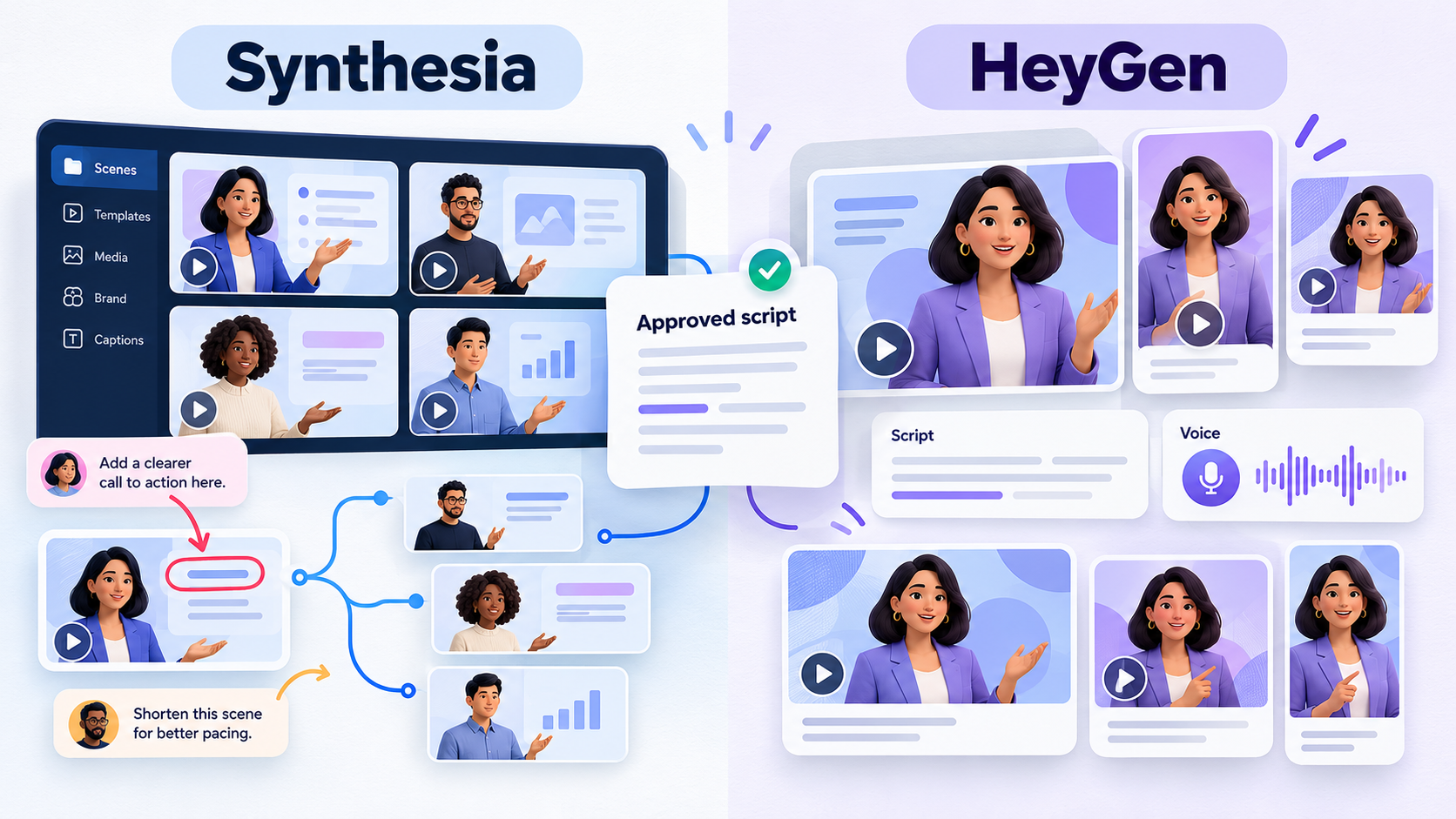
Original editorial illustration; this is not a product screenshot or a measured result.
Our documentation-based verdict is to consider Synthesia first for an organized training-video program and HeyGen first when a reusable presenter identity is central to the content. Both products overlap substantially. This assessment uses official materials checked on October 27, 2026, without a hands-on realism contest, speed measurement, or invented quality rating.
Synthesia vs HeyGen: the criteria behind the verdict
| Criterion | Synthesia | HeyGen |
|---|---|---|
| Strong reason to shortlist | A maintained business or learning-video library | A repeatable presenter-led content program |
| Public product emphasis | Business video creation, translation, and interactive learning | Personal avatars, script-directed production, and presenter performance |
| Editing responsibility | Keep lessons and supporting material coherent across revisions | Keep the identity and delivery appropriate to each approved message |
| Quality question | Does the finished lesson explain the intended material? | Does the presentation express the intended message for this audience? |
| Remaining evidence gap | Actual behavior with the team's content and delivery system | Actual behavior with the team's presenter, language, and script |
The distinctions are editorial priorities rather than exclusive feature boundaries. A customer should not infer that Synthesia lacks personal avatars or that HeyGen lacks collaboration. Their current product pages describe broader capabilities than that simplified division would allow.
Synthesia has a clear relationship with learning content
Synthesia's business platform page describes avatar video, translation, and interactivity, including branching scenarios and quizzes. Its learning and development page addresses training production specifically. Those descriptions make it a plausible first candidate when the video belongs to a continuing learning program.
A training video is more than a presenter reading an approved script. The material must remain understandable when a process changes, and the surrounding learning experience may need to respond to what the viewer knows. Interactivity is relevant to that job, even though a feature listing does not establish the educational value of a particular lesson.
For a team maintaining a catalog of lessons, the content lifecycle gives the product evaluation a concrete focus. It should also establish how the intended publication and learning systems handle the resulting material, rather than assuming that every plan supports every delivery requirement.
HeyGen puts the presenter at the center of the production story
The HeyGen homepage emphasizes personal avatars, script-directed editing, Video Agent, and team comments or editing. That positioning gives a buyer a clear reason to consider it when a recognizable speaker is a recurring part of communication. The identity of the presenter becomes a reusable asset around which content is organized.
For a specialist publishing regular explainers, continuity may be more important than the structure of a learning catalog. Viewers should recognize who is addressing them, while each message can vary with the subject. This hypothetical use case explains the editorial fit; it is not evidence that a generated presenter achieved a measured level of realism.
The continuing responsibility is control of the message and permission to use the identity. A polished presenter does not establish that a script is accurate or appropriate. The same principle applies to either platform, with particular practical weight when a recognizable person anchors a long sequence of generated videos.
Video translation is a shared capability, with separate approval work
Both providers describe video translation. It would be misleading to assign localization to only one side or to compare large language counts as though they were a uniform measure of quality. Support for a language is not the same claim as suitability for every vocabulary, tone, and audience in that language.
For a learning team, a translated term may need to match the language used elsewhere in the course. For a presenter-led campaign, the delivery may need to preserve the speaker's intended tone. Those are different approval priorities even when the underlying generation task looks similar.
No translated outputs were assessed for this article. The useful decision is therefore conditional: a platform can deserve a place on the shortlist because of its production model, while actual wording and delivery remain unverified for the proposed material. The comparison keeps those judgments separate.
Ease of use includes the second revision
A first draft can make either product look simple. The more revealing conceptual question is how the team expects to maintain the content once several people have reviewed it and the source material changes. The product relationship must make sense beyond the initial generation.
Synthesia's learning orientation gives a training team a reason to investigate the organization of its video program. HeyGen's presenter-oriented positioning gives a creator or marketing team a reason to investigate repeated production around a familiar identity. Neither observation is a measured claim that one editor takes fewer clicks or that one review process is always faster.
Operating effort includes scripts, approvals, language review, and keeping track of which version is current. Current plans, export behavior, team access, and usage accounting should be confirmed directly. This article avoids a price-per-minute table that would imply equivalent capabilities or untested cost savings across accounts.
A conditional recommendation for two different libraries
Shortlist Synthesia when the organization is primarily accountable for a coherent set of learning or business explanations that will be revised over time. Shortlist HeyGen when a repeatable personal presenter and a varied publishing program are the organizing assets. Include both if those jobs overlap, with a clear reason for the additional operating effort.
The site's Synthesia listing and HeyGen listing support initial discovery. A sensible final decision should be explainable in terms of the library, the audience, and the people who will maintain it, rather than the most striking sample on a vendor page.
FAQ
Which platform has more realistic avatars?
This article does not establish a realism winner. A current, comparable assessment using intended presenters and material would be needed to support that judgment.
Is Synthesia exclusively a training product?
No. Its official materials describe a wider business-video platform. Training is the scenario underlying this recommendation, rather than a limit on every possible use.
Does HeyGen support team work?
Its current homepage describes comments, tagging, and multi-user editing. Collaboration should not be omitted from a comparison simply because personal presenters are prominent in its positioning.
Conclusion
Synthesia vs HeyGen is a choice about the video program that deserves a permanent home. Synthesia is a strong editorial shortlist for maintained learning content; HeyGen is a strong shortlist for recurring communication built around a presenter identity. Both still need to prove their fit with the team's real scripts, audience, and delivery requirements.