
Zoomtopia 2026 presented a broader ambition than another meeting summary feature. In its October 20 announcement, Zoom described a Unified Context Layer connecting conversations with relevant work material. The strategic story is a move from recording what happened toward organizing what should happen next. The evidence available as of October 26 supports reporting that direction, while leaving its practical results an open question.
This is a dated announcement analysis based on official sources, not a product tutorial, a deployment test, or a market-share report. Statements about availability below preserve the status in the announcement. They do not establish that every account already has access or that a planned release has since completed.
Zoomtopia 2026 moves the conversation beyond the summary
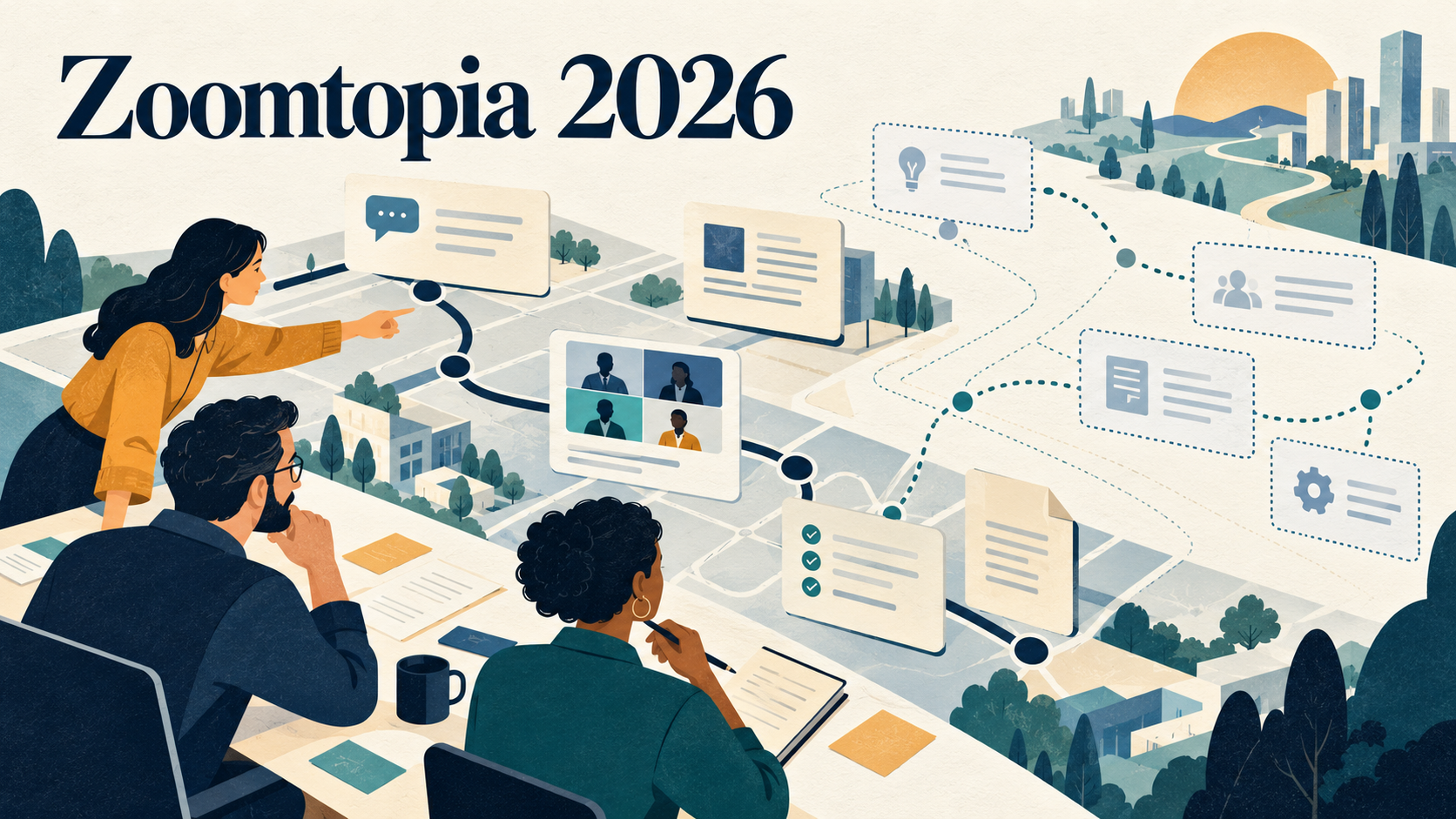
The October 20 press release frames shared context as the link between discussions and completed work. Its significance is architectural: conversations, documents, and actions are being presented as connected parts of an operating environment rather than separate destinations for generated text.
Our interpretation is that this changes the comparison buyers need to make. The question is no longer only which service can produce a readable recap. It is also where the record lives, what other material it can influence, and which system is expected to remain authoritative when information changes.
That interpretation does not prove that the proposed environment will be easier to maintain. It identifies the larger promise against which future product evidence should be judged. A new organizing layer can be valuable, but the diagram connecting applications is not itself evidence of a reliable operating process.
Available and announced do not mean the same thing
Zoom labels Search & Ask APIs and ZoomMate Agent Teams as available in the release. It places enriched notes in November 2026, a refreshed Zoom Chat experience in December 2026, and Live Meeting AI Agent in the first quarter of 2027. My Notes Workflows is described as expected in October 2026.
| Announcement status | What can reasonably be concluded |
|---|---|
| Available | The company reports availability; account eligibility still matters |
| Expected in a named month | A delivery intention, not proof of completed rollout |
| Expected in a later quarter | A roadmap item, not a current procurement entitlement |
These categories matter because a broad launch narrative can make separate delivery horizons feel like one finished product. This report does not combine them into a claim that the entire proposed experience is available today. An announcement is useful evidence of company direction and stated timing, with a narrower basis for describing actual access.
The naming also shows why dated reporting matters
The current AI product page presents ZoomMate. Readers arriving through older terminology such as AI Companion should therefore separate the search term they know from the product language used in current materials. This report uses the names in the sources rather than assuming the historical label identifies an unchanged package.
Naming alone does not establish a new capability. Equally, a familiar address is not proof that its commercial meaning has stayed fixed. That distinction is particularly relevant when buyers compare a remembered feature with a new collection of products, account requirements, and future commitments.
The editorial consequence is to preserve the date and source of each claim. A report can explain the transition without inventing a migration story, a universal entitlement, or a result from using the newly named product. Those would require evidence beyond the public pages consulted here.
Connected context increases the importance of authority
A summary is a document someone can review. A context layer has a wider ambition: its contents may inform later questions and actions. The possible benefit is reduced reconstruction of past discussions. The corresponding concern is that an outdated decision or an incorrectly interpreted note can acquire a larger role in subsequent work.
This is an analysis of the proposed architecture, not a reported failure in Zoom's implementation. It explains why correctness, correction, and access become central to the value proposition as meeting AI moves closer to execution. A richer connection between systems makes the ownership of information more consequential.
The useful distinction is between availability and operating readiness. A capability can be available while the organization still lacks agreement on who may use its output, correct its record, or approve the action that follows. Those are separate questions, and a launch report should not let one stand in for the other.
The implications reach beyond one vendor's feature list
For meeting products, this announcement sharpens an existing choice between an independent conversation record and a larger connected workplace. A buyer might favor either arrangement. Consolidation can provide a coherent center, while a specialized tool may fit an established process more closely. Neither outcome follows automatically from the size of a launch.
The relevant competitive question is the role the customer wants the platform to play. A product positioned around context and agents should be judged against that responsibility, not merely compared with a simpler recap tool on the number of features advertised.
Our productivity catalog is a starting point for related discovery. It does not turn this single-company announcement into proof of an industry-wide shift. The report's wider implications are editorial interpretation, explicitly separate from the facts Zoom published.
FAQ
Does Zoomtopia 2026 mean every announced feature is available?
No. The release includes different availability categories and future dates. An expected delivery period should not be rewritten as a completed rollout.
Does this report establish better meeting outcomes?
No. It analyzes public announcements and their implications. It does not provide an independent performance study or a claim of measured productivity improvement.
Why keep an as-of date on a product report?
Availability, names, and commercial packaging can change. The date helps readers distinguish the evidence considered here from later developments.
Conclusion
Zoomtopia 2026 is most interesting as a statement about context and responsibility, not as a flat checklist of features already shipped. The direction is clear in the official material; delivery horizons remain mixed. The next meaningful evidence will be how the available products and later releases connect that ambition to an operating experience customers can actually rely on.